Your first AI workflow should be boring. The Tiny Task Audit
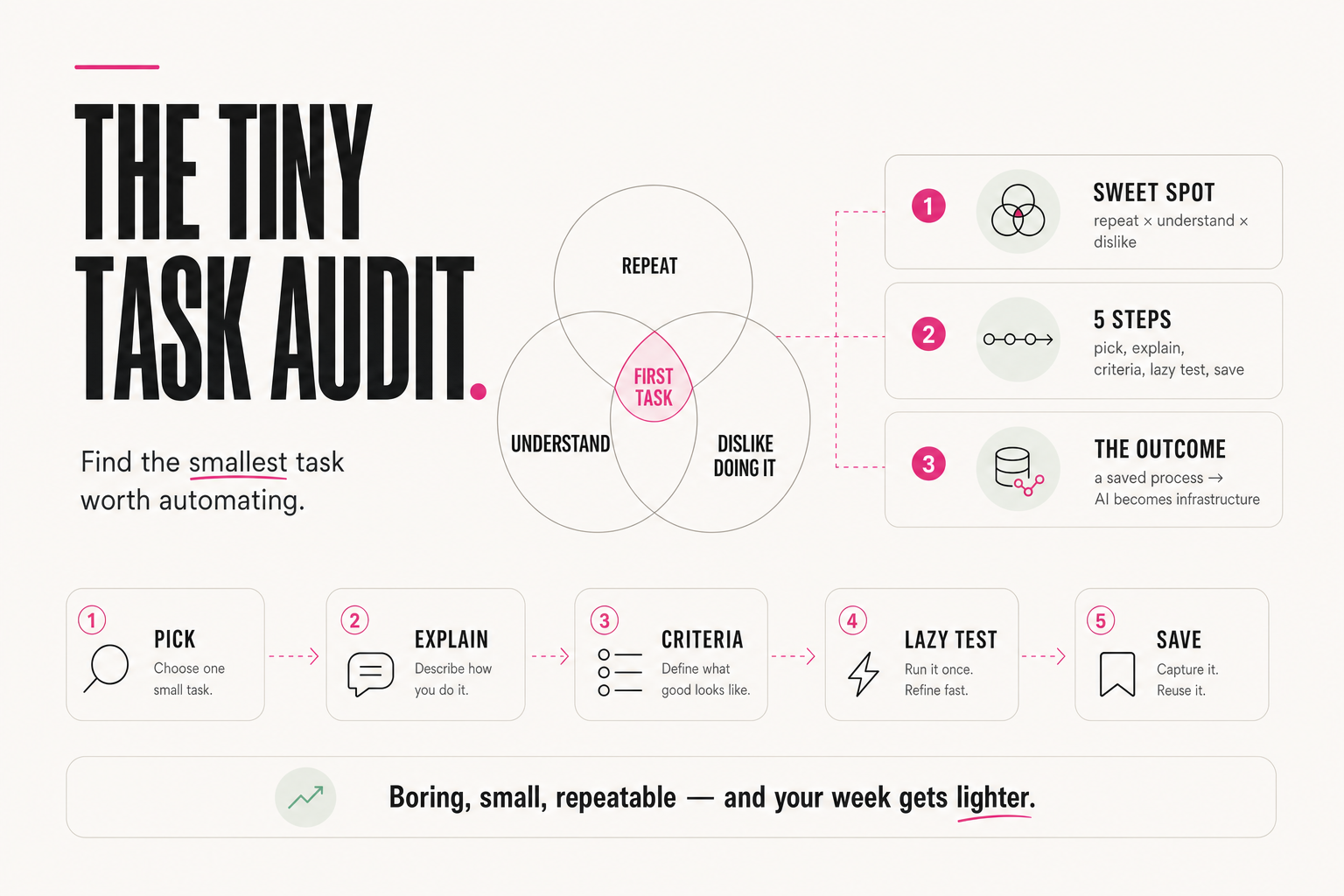
Most people choose the wrong first AI workflow — they start with something too big. Here's the simplest way to move from "I play with AI sometimes" to "I have one workflow that actually saves me time."
01 — Boring is right
Why should your first workflow be boring?
Most people start with something too big: "create my content strategy," "automate my sales," "build my assistant," "help me run my business." These are not bad goals. They are just terrible first tasks.
Your first AI workflow should be boring. Almost embarrassingly boring. Small enough that you can test it today, but useful enough that you would feel relief if it worked tomorrow. I call this the Tiny Task Audit — the simplest way I know to move from "I play with AI sometimes" to "I have one workflow that actually saves me time."
"Automate my sales" — a week of setup, unclear if it worked, disappointment.
"Turn this call's notes into a follow-up" — 10 minutes, immediately clear whether it worked.
02 — Step 1
Which task should you pick first?
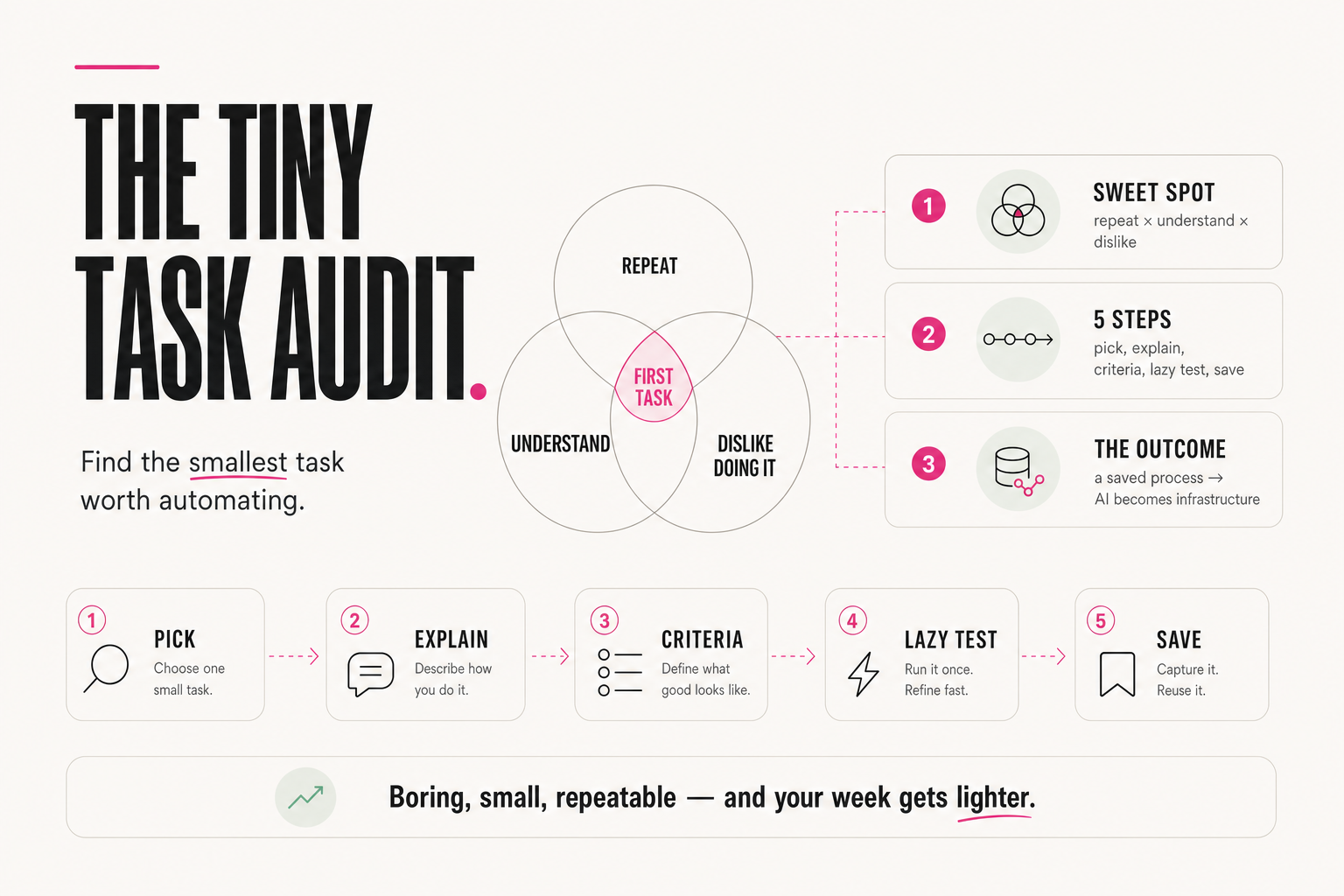
Do not start with a task where you are confused. AI will not magically give you expertise you do not have. Start with a task where you already know what good looks like, but doing it manually is annoying.
- turning a client call into follow-up notes;
- rewriting one idea into three post angles;
- preparing questions before a strategy call;
- checking whether a post sounds generic;
- organizing messy notes into a brief;
- comparing three options before making a decision.
The best first task usually has three qualities: you repeat it, you understand it, you dislike doing it from scratch. That is the sweet spot.
Take a candidate task and score 0-2 on each:
Do I repeat it at least weekly? ____
Can I say what "good" looks like within 10 seconds? ____
Annoying to do by hand, but not intimidating? ____

Score 5-6? Pick it first. Score 0-2? Not the right task —
pick another from the list above.
03 — Step 2
How do you explain the task to AI?
This is where people under-explain. They write "make this better," then are disappointed when the model produces average soup. Would you say that to a real person on your team? Probably not. You would say: here is what this is for; here is who will read it; here is what matters; here is what to avoid; here is an example of good work; here is how I will judge the result.
That is not "prompt engineering." That is basic delegation. AI just makes the quality of your delegation visible faster.— Anjela Petkova
Explain the task like you are onboarding a junior person. The more honestly you do it, the less "magic" you need afterward.
Task: [what needs doing]
Why: [what this is actually for]
Who reads it: [audience/recipient of the result]
Must have: [2-3 things that must be present]
Avoid: [2-3 things that definitely shouldn't be there]
Example of good work: [paste one if you have it]
How I'll judge it: [a concrete criterion]
04 — Step 3
What does "good" mean — before you ask for output?
This is the hidden part. Most people do not have an AI quality problem. They have an undefined-standards problem. If you want useful output, give the model criteria.
"A good result should be specific, direct, and written in the
language of the client. It should avoid corporate phrases.
It should name a concrete problem, not a vague benefit.
It should make the next action obvious. Here is an example: …"
This one step changes everything. Because without criteria, AI gives you the safest middle. And the safest middle is usually where all interesting ideas go to die.
05 — Step 4
Why test it with a lazy version of yourself?
This is my favorite test. Do not test your AI workflow only when you are focused, patient, and giving it perfect input — that version of you does not need much help. Test it with the version of you who is tired. The version who sends messy notes. Who forgets context. Who writes "make this usable" because there are three calls before lunch.
If the workflow only works when you behave perfectly, it is not a workflow. It is a fragile performance.— Anjela Petkova
A useful AI system should survive real life — not just the lab conditions of your best day.
Not: neat notes with timestamps and headers.
But: "call was about their budget and they're probably not ready
until fall, send a decent summary for the team pls."

If the workflow produced something useful from THIS, it's real.
If it fell apart, fix the instructions — not the input.
06 — Step 5
Where do you save a process that worked?
This sounds too simple, which is why people skip it. But this is where AI adoption either becomes a system or disappears into chat history. When something works, save it: the prompt, the example, the criteria, the messy input that produced a good result, the improved version.
Your knowledge base does not have to be fancy at first — it just has to exist. Because the moment your good AI process lives only inside one chat, it is already half lost. The point is not to collect prompts. The point is to build memory around your work: your idea goes in, and your context, standards and examples are already there. The output gets better because your thinking became easier to reuse.
Task: [name]
The prompt/instructions that worked: [paste it]
"Good" criteria: [paste it]
An input/output example that worked: [paste it]
Date and what to improve next time: [a note]
07 — The shift
How does AI stop being a toy and become infrastructure?
That is the real shift. Not "I used AI once," but "I built one repeatable process." And then another. And then another. That is how AI stops being a toy and becomes infrastructure — quietly, one boring task at a time.
1. What task do I repeat often?
2. What task do I understand well but dislike doing manually?
3. What does a good result look like?
4. What examples can I show the model?
5. What lazy or incomplete input should I test it with?
6. Where will I save the process if it works?If you can answer these six questions, you do not need a perfect prompt — you have the beginning of a system. So: what is the most boring task in your work that would make your week noticeably lighter if AI handled 60 percent of it?
FAQ
Why not start with a big task like "automate my sales"?
Because it's a great goal but a terrible first task: too big to test today and too vague to tell whether it worked. A first workflow should be small and understood — one where you already know what good looks like. Big things are built from small repeatable processes, not the other way around.
How is the Tiny Task Audit different from finding a perfect prompt?
It's not about phrasing — it's about task choice and standards. Pick a task you repeat and understand, explain it like onboarding a junior, give criteria for "good," test it with a lazy version of yourself, and save the working process. Answer the 6 audit questions and you no longer need a perfect prompt.
What does "test it with a lazy version of yourself" mean?
Testing the workflow not on perfect input while focused, but on messy notes and incomplete context — like on a real busy day. If the process only works with perfect input, it isn't a workflow, it's a fragile performance. A useful system survives real life.
Why save the process if AI is always at hand?
Because a process living only inside one chat is already half lost. Saving the prompt, criteria, examples and the input that worked turns a one-off success into a repeatable system: your idea goes in and the context and standards are already there. That's how AI becomes infrastructure, not a pile of random requests.