How to start with AI if you've never really tried
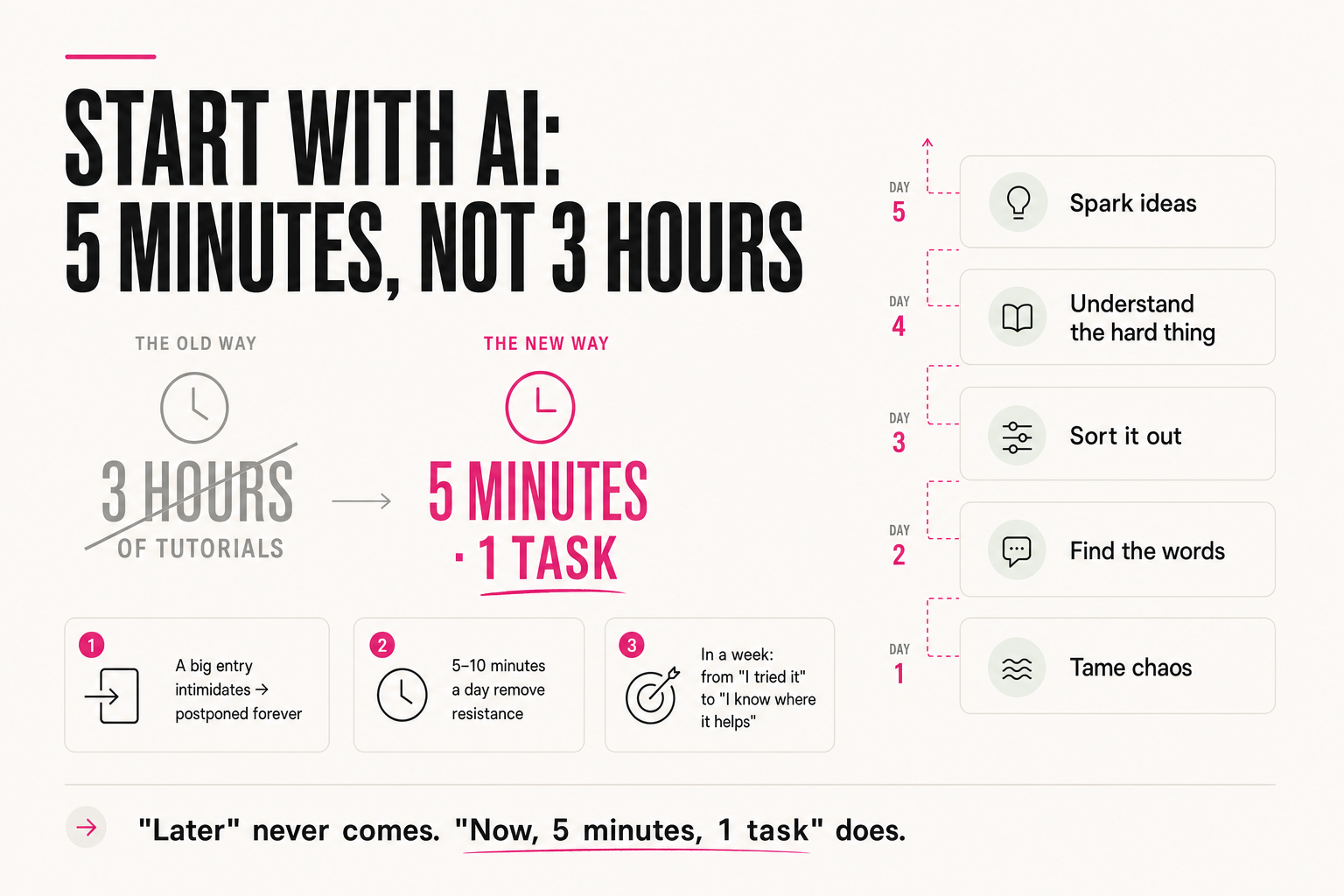
You don't need three hours of tutorials and the "perfect moment." You need five minutes and five simple tasks. Here they are.

01 — The "later" trap
Why does "I'll figure it out later" never come?
We think adopting something new — especially something like ChatGPT — means rearranging our schedule, blocking three hours to learn, watching five tutorials, "unpacking the meaning"… and only then, once it all lands perfectly, can we start.
But that "later" never comes. Because life always has deadlines, crunches, and people who need you right now. So you put it off — not because you don't want to, but because the entry feels too big. The fix isn't finding three hours. The fix is shrinking the entry to five minutes.
"I'll block time Saturday, watch tutorials, figure out prompting" — Saturday passes, no time was found, the guilt stays.
"I'll paste this email into ChatGPT right now and ask for the gist" — done over lunch, in passing, no prep needed.
02 — Five minutes
Why start with 5 minutes, not 3 hours?
You don't need to "write 20 stories," "map out a content strategy," or "work on your brand voice, reveal your archetype and warm up the audience in three steps." That's intimidating, so it doesn't get done.
Start with something very simple, doable and genuinely useful: one short task, 5–10 minutes, no more. Simple, human, almost fun — the kind you'll definitely finish. Small size isn't a compromise, it's a strategy: it removes resistance, and a completed action gives you what no tutorial can — experience.
"Later" never comes. "Now, five minutes, one task" does. That's where everything else begins.— Anjela Petkova
The big task: [e.g. "figure out a content strategy"].
Ask yourself: what's the smallest piece of this I can do right
now, in 5 minutes, with no prep?
Example: not "strategy" but "ask AI to sketch 5 post topics for
this week." Do only that — and stop.
03 — Five tasks
Which five tasks should you do in the first days?
Here are five starter tasks — one a day, each 5–10 minutes. No schemes, just open ChatGPT and try:
Day 1. Tame chaos: paste a long email/thread →
       "pull out the 3 main points and what they want from me."
Day 2. Find the words: "rewrite this message softer but firm on
       substance" (the one you keep hesitating to send).
Day 3. Sort it out: dump messy notes →
       "turn this into a prioritized to-do list for the week."
Day 4. Understand the hard thing: "explain [topic] in plain words,
       like I'm 12, with one example."
Day 5. Spark ideas: "give me 5 options for [your task] and help me
       choose by my criteria."
Notice: none requires "becoming a techie." They're ordinary things you do anyway — just now with an assistant.
04 — The quiet shift
What's actually happening over those five days?
Each day you're not just practicing pressing buttons. Bit by bit you build a system around yourself — in text, in daily life, in money, in habits, in your head. You start to notice which tasks offload easily, which words get you what you want, where AI saves time and where it gets in the way.
That's the real entry into the topic: not through theory but through a week of accumulated personal experience. By day five you don't have "I tried ChatGPT" — you have "I know where it's useful to me."
After each of the 5 tasks, write one line:
Task: ____   Helped a lot / a little / not much: ____
Which wording worked best: ____

By day five you're holding not theory but a personal map:
where AI genuinely saves you time.
05 — The minimal base
What do you need to grasp to go further?
Once the five tasks are done, a simple three-step base helps — you don't have to learn it in advance, it forms on its own:
- See where AI is needed. Which tasks it genuinely helps with and which are faster by hand. The first week shows you exactly this.
- Break the task into steps. A model runs on a clear algorithm, not a vague "do it well." Describe the process as you would for an intern.
- Hand it over. Once the first two steps are done, handing it to the model turns out to be surprisingly easy.
Most people stall not because AI is hard but because they try to jump straight into "strategy." Do the opposite: five minutes of practice first, the base second — and it stops being scary.
"Help me with a post" — AI returns generic text, and it's unclear what to do with it next.
"Here's the topic, here are 2 of my posts as examples, here's the length — write a draft in this style" — a concrete result you can edit right away.
06 — Right now
Which task can you do in the next 5 minutes?
Don't close this article thinking "I should try that sometime." Do Day 1 right now: take any long email or thread, paste it into ChatGPT, and ask for the 3 main points and what they want from you. Five minutes — and you already have personal experience instead of an intention.
Here's the email/thread: [paste the text].
Pull out the 3 main points and what they want from me — briefly,
no preamble.Don't wait for the perfect moment and three free hours — they won't come. The entry into AI is five minutes and one simple task. Skill grows from doing, and the system around you assembles itself, one task a day.
FAQ
Do I need to understand tech to start?
No. The first tasks are ordinary everyday things (condense a long email, find the right words, sort your notes) that don't require "becoming a techie." Just open ChatGPT and describe the task in plain words. Technical depth comes later and only if you want it.
Why small tasks rather than serious ones right away?
Because a big entry is intimidating and gets postponed — that "later" that never comes. A small 5–10 minute task removes resistance, gets finished, and gives you experience. A few such tasks build the skill faster than three hours of tutorials with no practice.
How long until I feel the benefit?
Usually a few days of 5–10 minute practice. By the end of the first week you move from "I tried ChatGPT" to "I know where it's useful to me": you see which tasks offload easily and which words get the result you want.
What do I do after the first five tasks?
Pick up a simple three-step base: see where AI is genuinely needed, learn to break a task into steps, and hand it to the model. You don't learn it in advance — it forms from your first week of practice, and moving forward gets easy.