Why the same prompt gives different results. It's not the wording
How a model actually picks words — and the prompt formula that steers it to the answer you want.

01 — The mechanic
How does a model actually "think"?
ChatGPT and any text model doesn't think in the usual sense. The most accurate comparison is your phone's autocomplete. You type "Hey, how are" and it suggests "you." It doesn't understand the sentence — it predicts the next word from the millions of messages it has seen.
A model is the same autocomplete, only a million times smarter and trained on the whole internet. Same mechanic: you give words, it predicts the next, then another, and so on for the whole text. Understanding is an illusion created by the accuracy of the predictions. This doesn't diminish the model — coherent text comes precisely from prediction. But it changes how you should talk to it.
Open your phone keyboard and type: "I'm feeling really..."
Look at the suggestions — the phone isn't offering meaning,
it's offering the statistically likely continuation.
A large model does the same thing, just accounting for your
entire conversation instead of the last three words.
02 — Probability
Why does the same prompt give different answers?
Here's the answer to the headline. At each step the model doesn't have one "correct" next word but a whole probability distribution: "you" — 60%, "things" — 20%, "doing" — 8%, and so on. And it doesn't always take the most likely one — it samples from the distribution. So two runs of the same prompt go down different branches and produce different text.
So it really isn't only the wording: there's built-in randomness. But you bound that randomness — the narrower the distribution at each step, the more stable and precise the answer. And you narrow it with words. A vague prompt leaves the distribution wide — hence the spread and the average. A precise prompt narrows it.
You can't remove the randomness entirely. But you can make it safe — by narrowing the distribution to the options you're happy with.— Anjela Petkova
Run the same vague prompt ("write a post about productivity")
3 times in fresh chats.
Write down the first line of each answer.
Then do the same with a precise prompt (see section 05).
Compare: the vague one gives three different openings; the
precise one gives variations on the same idea.
03 — Branches
Why does each word launch its own branch?
Every word in your prompt launches its own branch of predictions. You're not asking — you're setting a direction. The word "secret" pulls the model into one region of probabilities, the word "guide" into a completely different one. They drag the text before the first letter of the answer is written.
See how one swapped word changes everything:
Clickbait branch: "one trick that changes everything," emojis, intrigue.
Systematic branch: structure, steps, reasoning.
Choosing the right words is real work, and this is what real prompting is: not prettier phrasing, but picking the levers that lead to the branch you want.
04 — Empty words
What does "make it good" mean to a machine?
There's a class of words that mean nothing to a model — fillers: "good," "professional," "viral," "interesting." To a human they feel like a requirement. To the machine they're noise.
When you write "make it good," the model can't tell which way to predict. Good for whom? By what criteria? In what style? It's like turning the wheel without turning it a single degree — and being surprised you drift straight into the internet's average. A filler doesn't narrow the distribution, so you get the most likely, i.e. the most banal, option.
Scan your last prompt for: good, cool, quality, professional,
interesting, viral, effective, modern, deep, catchy.
Replace every one you find with specifics using the section 05
formula (for whom + criterion + format) before you send the prompt.
05 — In practice
How do you write a prompt that hits the target?
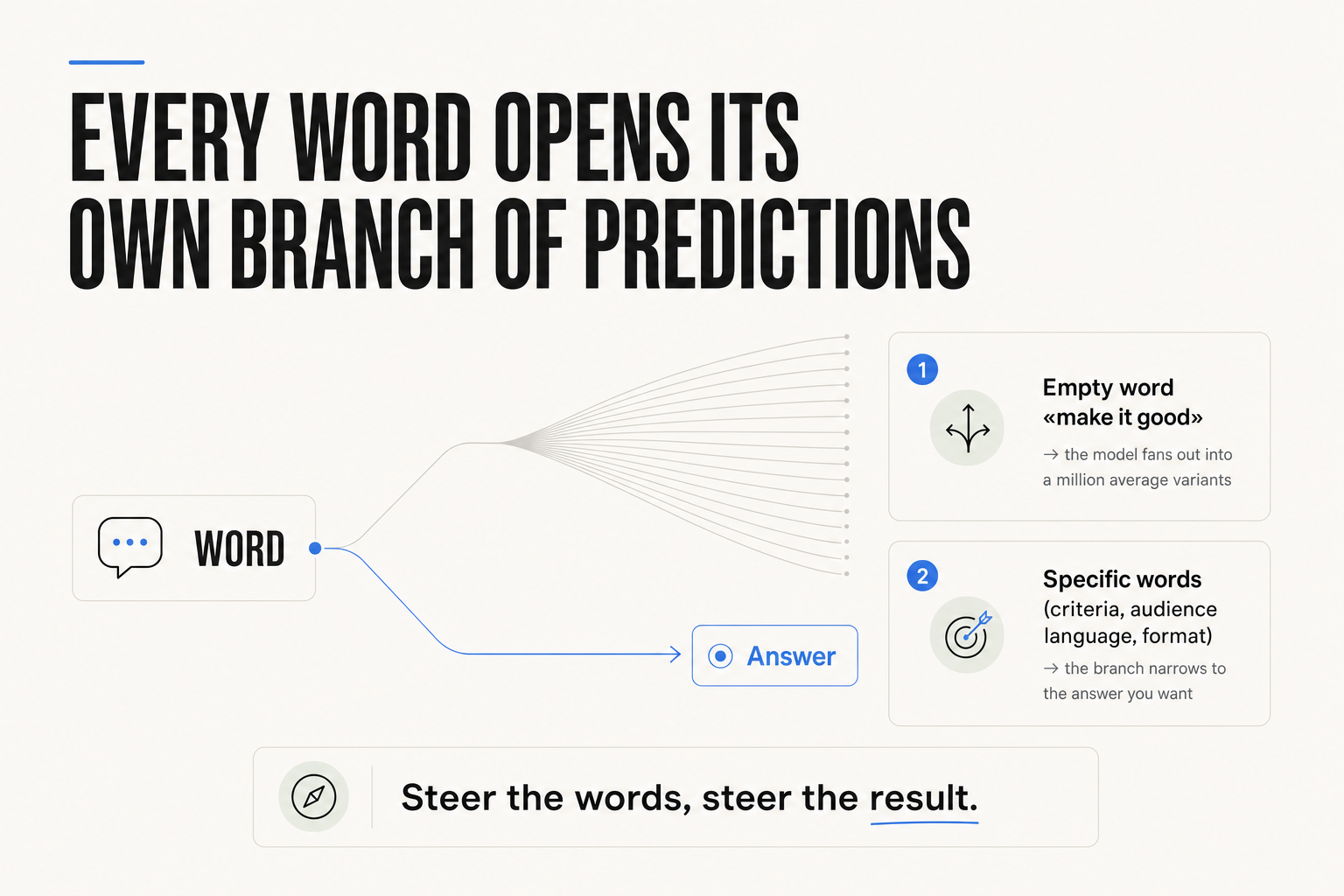
The recipe follows straight from the mechanic. If every word is a lever, your job isn't to persuade the model but to replace fillers with specific words that set the branch you want:
- Find the filler. Underline "good," "cool," "professional," "viral," "interesting" in your prompt — each sets nothing.
- Ask "which kind?" By what criteria, for whom, in what style. The answer to that question is the words you need.
- Replace it. Instead of "make a viral post" → "write a post with a question hook in the first line, in practitioners' language, one idea per paragraph, no emojis."
"good"         → for whom + criterion + format
"professional" → whose professionalism (lawyer? copywriter?) + markers
"viral"        → which hook + which emotion + length
"interesting"  → which twist + what the reader didn't know before
Here's what it looks like live — one prompt across three iterations:
v1: "Write a viral post about time management"
    → the internet's average, "5 tips to get more done"
v2: + "a question hook in line one, for busy parents"
    → warmer, but still a tip-list
v3: + "one counterintuitive claim, no lists, an example from
    a weekday morning, 700 characters"
    → on target: an actual idea, an actual rhythm
What changed wasn't "persuasive force" but the number of levers: each added specific cut off a cliché branch. The randomness stays, but now it spins inside the branch you want — and even different runs hit the target.
FAQ
Does a model really not understand my request?
Not in the usual sense. A text model is a supercharged autocomplete: it doesn't grasp meaning, it predicts the next word from training. You give words → it predicts the next → then another → and so on for the whole text. Understanding is an illusion created by prediction accuracy.
Why doesn't "write it well" work?
Because "well" is a filler word. To a model it sets no direction: well for whom, by what criteria, in what style. It doesn't narrow the probability distribution, so you get the most likely — i.e. the most banal — option.
Why does the same prompt produce something different each time?
Because at each step the model samples from a probability distribution rather than always taking one option — built-in randomness. You can't remove it entirely, but you can narrow the distribution with precise words, and then different runs still land in the branch you want.
So is the prompt more important than context?
No — they're two different things. The words in your prompt set the branch, but the material the model builds the answer from is context (your files, examples, data). The prompt steers; context fills. The strongest combination is precise words plus rich context.