I stopped writing prompts — and AI got more reliable
Why the race for the perfect prompt loses — and which approach gives a repeatable result. With worked examples.

01 — The mechanic
What does AI actually do when you give it a prompt?
Here's what almost every "AI for marketers" guide skips: AI doesn't understand your request — it predicts it. When you write "write a post about X," the model doesn't think. It matches patterns across billions of texts and essentially asks itself: "when a request is phrased like this, what does the answer usually look like?" And it returns exactly that.
The average. The statistical middle of everything ever written in response to a similar request. That's why polishing one phrasing hits a ceiling: you move the request, but you're still pulling from the same middle. To leave it, you have to change not the words of the spell but how the task itself is structured.
You see it instantly. To "write a post about productivity," nine models out of ten return "productivity isn't about doing more — here are 5 habits." It's not a bad model. It's the most likely answer — that statistical middle. And polishing adjectives won't get you out: "make it catchy" only nudges the same middle.
Ask the same request twice in a row, changing only the adjectives
("catchy" → "emotional").
If the answer's structure and logic stay the same and only the
words differ, you're polishing phrasing, not changing the task.
If you want a different result, change not the adjective but
the request's structure itself (see section 03).
02 — The trap
Why is the "perfect prompt" a trap?
A few years ago a comment appeared under one of my posts: "How do I describe myself so people instantly want to hire me?" I sat down to write the perfect prompt. Clear goal, specific format — how hard could it be.
I ran it across ten niches. Coach, designer, lawyer, photographer, consultant. Made the prompt longer. Shorter. Added bios I admired. Stripped it all and started over. Swapped models. The result was always "fine" — and never right. Because a good bio assembles differently for a lawyer and a photographer, while one prompt tried to cover everyone with one average shape.
"Write a compelling professional bio for [niche] that instantly
makes people want to hire this person. Make it catchy, confident
and memorable. Show expertise and results."
Looks solid — goal, tone, criteria all present. But across ten niches it produced the same average shape of "results + confidence," because it never asked what specifically set this person apart.
One perfect prompt tries to do in a single step what an expert does in six.— Anjela Petkova
03 — The shift
What's more valuable than the wording?
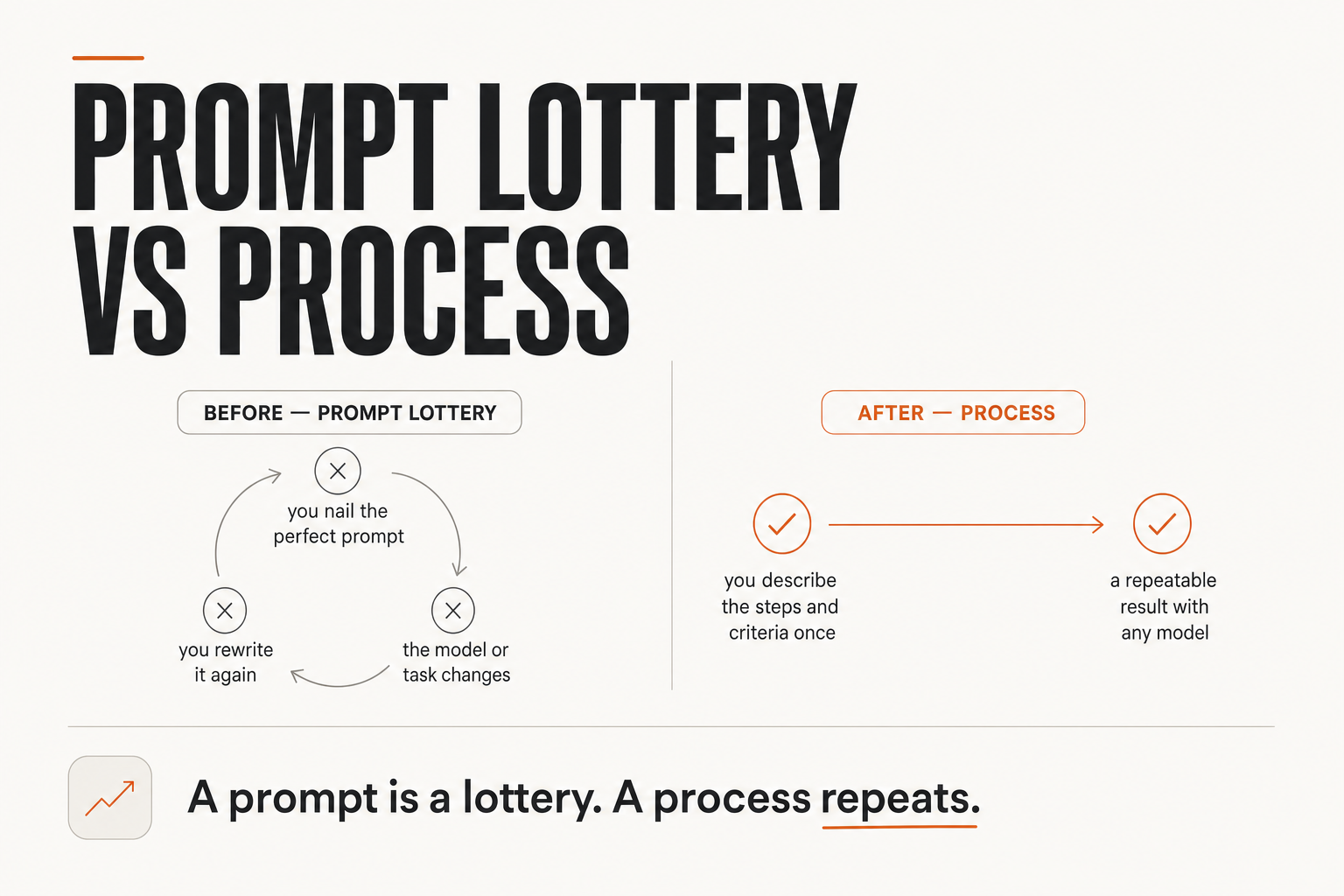
The flip is simple: instead of describing the desired result, describe the process an expert would use to reach it. And run each stage as a separate conversation.
The same bio task, rebuilt in steps:
Step 1 — questions: "I need a professional bio for niche X.
   Before writing anything, ask me the 10 questions a good
   copywriter would need answered. Nothing else yet."
Step 2 — positioning: from the answers, build 3 angles of
   what sets the person apart. I pick one.
Step 3 — draft in that angle. Step 4 — edit to the voice."Write a catchy professional bio" → average, off-target.
Questions → positioning → draft → edit → on target.
The difference isn't the beauty of the phrasing — it's that you let the model walk an expert's path instead of guessing the finish in one shot.
04 — What remains
Which skill doesn't go out of date?
Prompts will change, models will improve. The "best prompts for marketers 2026" you saved today will be half-obsolete by year-end: a new list, a new model, a new set of tricks.
But the ability to think in steps doesn't age. Every time you decompose a task this way, you understand it more deeply, get faster, and feel more precisely which parts only you can do and which you can hand off. A prompt is a lottery you replay on every model change. A process is an asset that carries to any model and only gets stronger.
You see the difference in stability. The same "perfect prompt" lands today and misses on a new model version tomorrow — and you're back to tuning it. A process of steps doesn't break that way: the model changes, the steps stay, the quality holds. That's why I stopped collecting prompts — I collect processes.
Take your usual one-line prompt: [describe it].
Ask yourself: "how would a real expert solve this task —
what 3-4 steps would they go through before delivering the final?"
Turn each step into a separate message: clarifying questions first,
then a draft, then edits. Stop compressing it into one.Don't hunt the perfect phrasing. Describe the expert's process and run it in steps — it's repeatable, doesn't age, and gives a stable result instead of a lottery.
FAQ
Does this mean prompts aren't needed at all?
They are — but as lines in a conversation, not a magic spell. One perfect prompt tries to do in a single step what an expert does in six. What works better isn't polishing the phrasing but breaking the task into steps and the context you bring into it.
Why does AI produce such templated text?
Because the model doesn't understand the request, it predicts it. To "write a post about X" it returns the statistical average of everything written in response to similar requests. To leave the average, change not the words of the spell but the structure of the task — decompose it into steps.
What does "thinking in steps" actually mean?
Describe the process an expert would use, and run each stage as its own conversation: first clarifying questions, then positioning, then a draft, then editing. The model walks the path instead of guessing the finish in one shot.
Isn't this slower than one prompt?
The first time, a little — but the result is more stable and doesn't need rewriting. And you reuse the process afterwards, even turn it into a project or an agent. One prompt has to be re-optimized on every model change; a process carries over as-is.