The prompt is only 25% of the result. The other 75% is context
Context isn't a clever brief — it's your materials: files, frameworks, data, even call transcripts. Here's why, with real numbers, and how to give the AI the folder so it pulls context itself.

01 — The trap
Why does a good model keep handing you clichés?
You want a LinkedIn post, so you type the obvious thing:
Write a LinkedIn post about productivity.And you get the post everyone gets — "productivity isn't about doing more, here are 5 tips 🚀." So you blame the wording, add "crisp, engaging, strong hook," and get the same thing, more confident about itself.
It's not just posts, and it's not just you. One agency owner spent five hours configuring an AI agent. It didn't work. Three more hours of tweaks — still wrong. The agent wasn't the problem; the foundation was. As he put it, the model can't think for you — your experience is the thing that has to be put in. Polish the prompt all you like; with nothing underneath it, you're refining an average.
02 — The mechanic
Why does "no context" always become a cliché?
Here's the part people skip: the model doesn't understand you. It predicts. People assume AI reads their mind — it just guesses the most likely next words.
One breakdown of this puts it well: every word in your prompt is a setting that opens different branches of prediction. With a thin request, the model takes the general templates — the clichés. With rich context, it builds the answer around your specific task, accounting for dozens of micro-details it otherwise can't see. The cliché isn't a bug. It's what "most likely" looks like when you've given it nothing to narrow down.
The model isn't missing instructions. It's missing your materials.
Thin: "write a post about delegation" → the cliché about the
  importance of delegation that's been written a thousand times
Rich: "here are 2 of my posts (voice), here's a case from my
  practice where delegation failed because of [specifics], here's
  the conclusion I drew — write a post based on this"
  → text that can't be mistaken for anyone else's
03 — The redefinition
What is context, really? (it's not a brief)
This is where most advice goes wrong — it treats context as a tidy brief: audience, goal, tone. That's the visible tip. The mass underneath is the real thing:
- your best work — the pieces that actually sound like you;
- your frameworks and SOPs — how you actually do the thing;
- your data and numbers — real results, not invented stats;
- your call transcripts — recordings of how you explain things to a client, in your own words;
- your standards — what you accept and, just as important, what you reject.
"Context" isn't a paragraph you write. It's the body of knowledge that lives in your head and your files — and the model has read the whole internet and none of it.
Best work: 3 posts where clients said "this is literally me"
Framework: your client-diagnosis process — steps 1-2-3
Numbers: "freed up 12 hours a week in 6 weeks" (a real case)
Transcript: 10 minutes of a call where you explained the method aloud
Standards: "never give generic advice with no example"
04 — Show, don't describe
How much does showing instead of describing actually change?
Describing your context ("bold, expert, conversational") is the weakest form of it — adjectives are vague, and you'll phrase them differently every time. Examples are the strongest form. And the gap is measurable.
One agency owner who tested this found that adding examples when setting a task made the output roughly five times better. His takeaway was blunt: don't skimp on inputs — describe in detail who you are and what you want. Same model, same task; the only change was handing it real examples instead of describing what he wanted.
"Write in a bold, witty, expert voice."
"Here are 3 posts I've written. Match this voice, structure and level of specificity." (attach the 3 posts)
05 — Your hidden materials
What's the most underused material you already have?
Call transcripts. On a call you explain your method better than you ever write it — real examples, the exact words a client understood, the order you reveal things. That's premium context sitting in your recordings.
One product marketer leaned into exactly this: she fed in transcripts of her customer-research calls and pulled about 30 lead-magnet ideas in 20 minutes, using the AI as a buddy to riff with — grounded in real customer language instead of generic brainstorming. The ideas were good because the input was hers, not the internet's.
- 5–10 of your best pieces (voice + structure)
- your offer / positioning doc (what you actually sell)
- transcripts of 3–5 real calls (how you explain it out loud)
- your frameworks / checklists (how you do the work)
- a short "never do this" list (your standards)
06 — Why it's your edge
Why is your context a competitive advantage, not just a quality tweak?
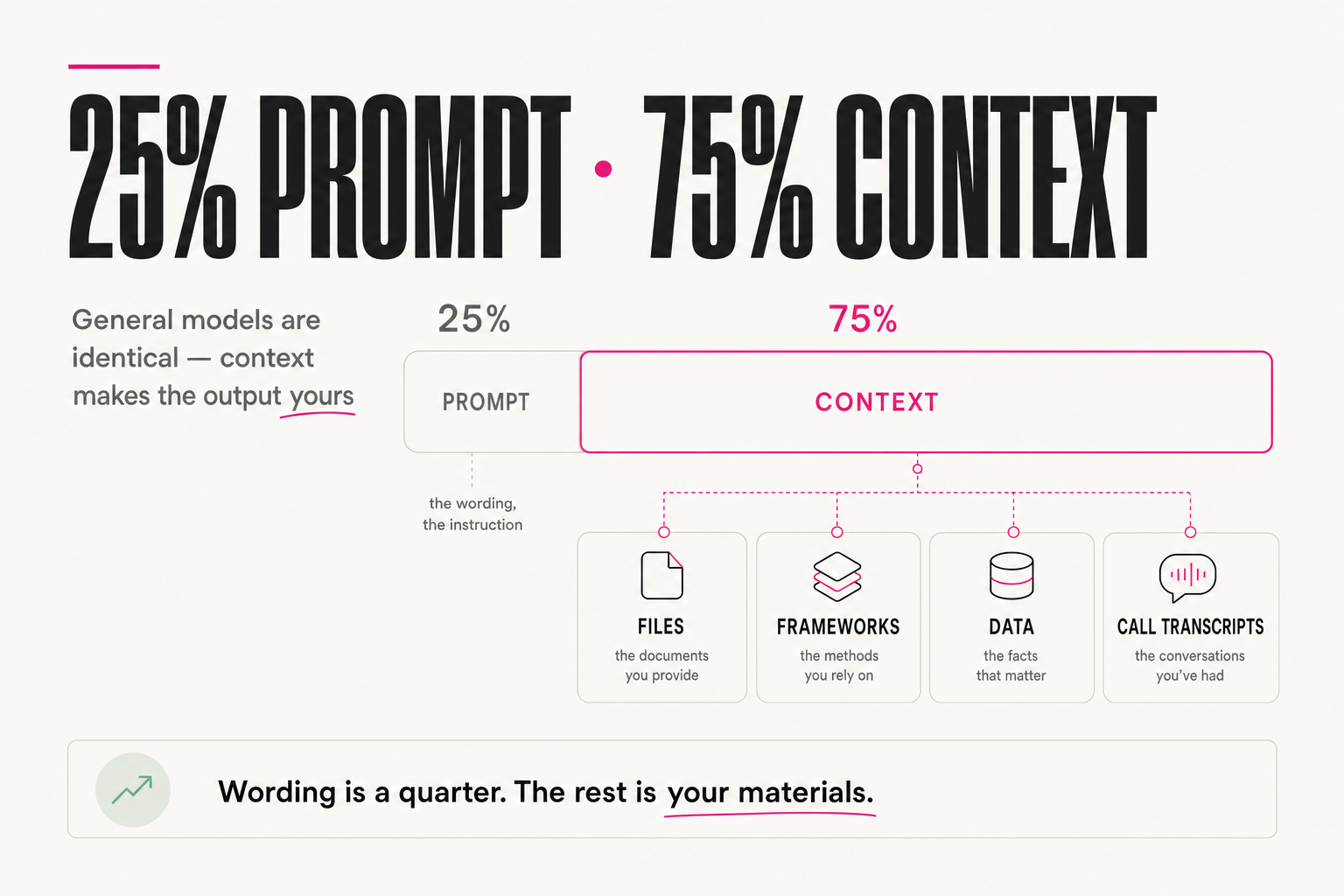
Because every general model — OpenAI, Claude, the rest — ships with basically the same knowledge and the same default approaches. If everyone is prompting the same models, the prompt can't be your edge. Your data is.
Feed a model the results of hundreds of campaigns, analyzed for what worked and what didn't, and the answer you get is a completely different, far more precise thing. Same engine; your context creates a giant difference in the output. That's the whole game: not a better prompt than your competitor, but a better library behind it.
Context isn't a brief — it's your materials: files, frameworks, data, call transcripts. Don't describe them. Hand them over — and since general models are all the same, your materials are the only durable edge you have.
07 — The real unlock
What if you don't hand-pick — and just give it the folder?
You don't have to choose which files to attach for every task. You can give the AI access to your folder of materials and let it find and assemble the right context itself, per request.
The simplest version is a project. Create one, describe the voice you want and drop in examples, and over time it produces text close to your actual voice — because the context now lives in the workspace, not in each prompt. Scale that up to your whole knowledge folder and you get retrieval: you ask for a post on an objection, and the AI goes and pulls the calls where it came up, the framework that answers it, and the number that proves it.
You: "Draft a post on the 'we'll build it in-house' objection."
AI: (searches your folder) → 2 call transcripts where it came up,
    your counter-framework, last quarter's retention number →
    writes the post from your actual material.
That's the jump from a tool you spoon-feed to a second version of you that already has your knowledge and just uses it.
08 — Build it once
How do you set this up so you're not feeding it every time?
Build a context folder once and keep it alive:
/my-context
  /voice        → best posts, sample emails
  /calls        → transcripts (raw is fine)
  /frameworks   → how-I-do-X docs, checklists
  /proof        → results, numbers, case notes
  /standards    → "never do" list, brand rules
Every time a call gets transcribed, a framework gets written, a result comes in — it drops into the folder. Your context compounds, and because the AI reads from it, your output gets sharper every month without you writing a single longer prompt. The setup is a one-time cost; the average is what you pay forever if you skip it.
FAQ
So what actually counts as "context"?
Your materials, not a brief: your best work, frameworks and SOPs, real data and numbers, call transcripts, FAQs, and your standards. The audience/voice note helps, but it's the small part — your knowledge is the rest, and it's the part the model can't guess.
Do I really feed it call transcripts?
Yes — they're the most underused context there is. On a call you explain your method better than you write it. One marketer pulled around 30 usable ideas in 20 minutes by feeding in her customer-research transcripts. Drop them in and the model writes from real language, not generic templates.
Isn't a better prompt enough?
Only up to a point. Everyone's prompting the same general models, so the prompt can't be your edge. Examples alone made one tester's output about 5× better; your data is what makes the answer different from everyone else's. Fix context first, then refine wording.
What does "give it the folder" mean technically?
A project or custom GPT with your files attached, a connected knowledge drive, or a retrieval (RAG) setup. The point is the same: the AI can search your materials and pull the relevant ones per task, so you don't hand-pick every time. Use a workspace you control and keep client-sensitive material out of anything you wouldn't trust with it.