I ran 70M in ad traffic. Here's why "cool" AI automation burns money
The checklist of metrics without which AI just multiplies zero faster.

01 — The problem
Why does volume tirage rather than cure?
I've watched a team go through this. A real setup: AI generation, auto-formatting, scheduled posting, three platforms, a hundred pieces of content a month. Reach before launch — about zero. Reach after — still about zero. Only now, on top of the zero, there's overhead, a complex system to maintain, and content that looks active but means nothing to anyone.
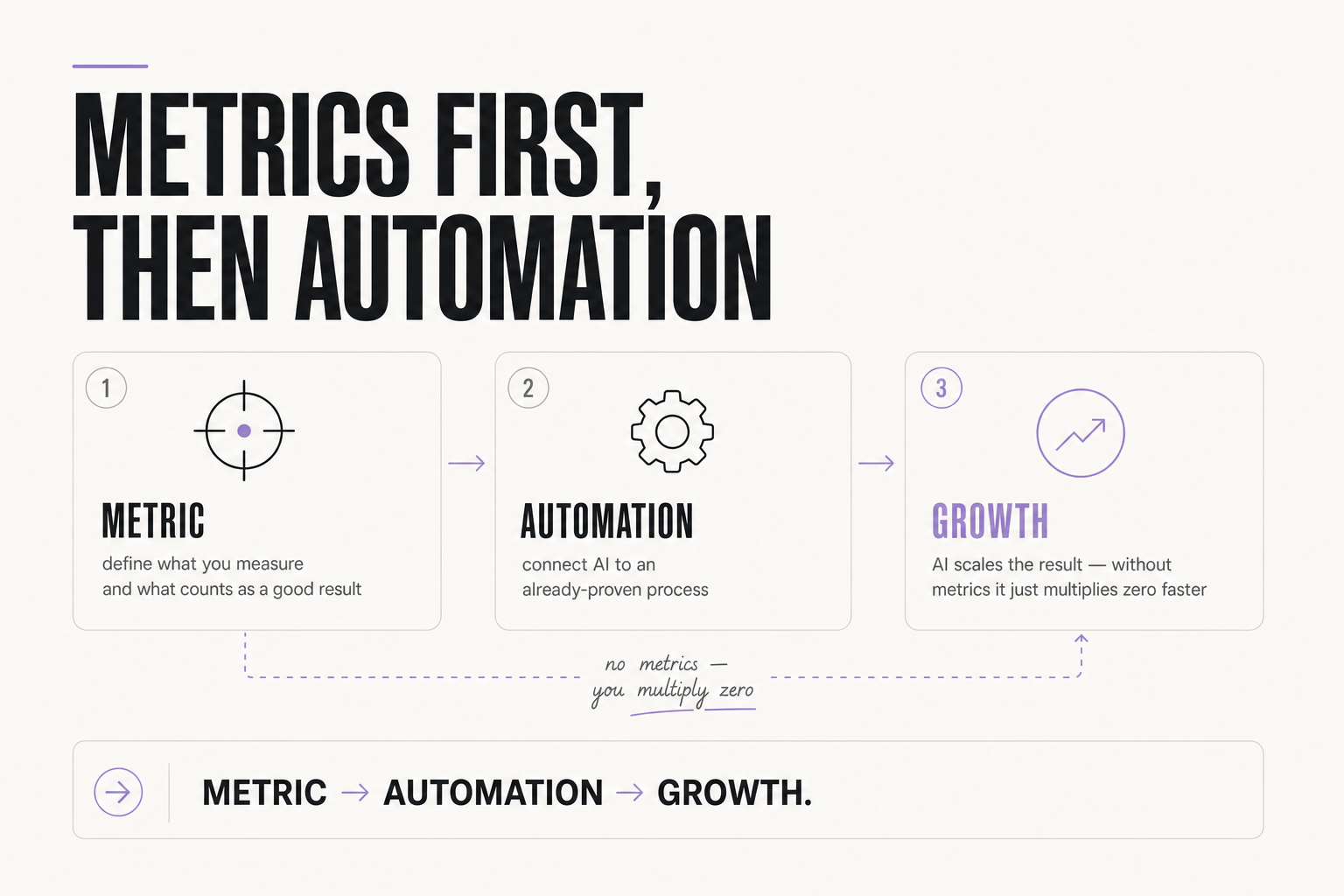
Zero scaled into zero. That's automation's core trap: it doesn't create a result, it multiplies what's there. Zero becomes zero ×100. A working process becomes working ×100. So "what are we automating" matters more than "how."
Automation is a multiplier. Multiplying emptiness means getting the same emptiness — faster and more expensively.— Anjela Petkova
And you pay twice. First in money and time on the system itself: it has to be set up, its integrations fixed, fed. Second in attention: a feed stuffed with AI content "about nothing" devalues even the live things you do publish. A hundred pieces a day isn't a hundred chances — it's a hundred ways to look busy at zero result.
1. Can I name a concrete number (leads, sales, saves) my current
   content moves? ____
2. Did that number grow last month or stay flat?
3. If I doubled my posting volume tomorrow, am I confident the
   number would double too, not just the post count?
No answer on 1, or "no" on 3? Don't automate until you've
worked through section 02.
02 — The metric
What should you measure before automating?
Here's where people go wrong. They think the problem is the prompt: better prompt, better content. They buy prompt packs, take courses, test system messages. The content gets a little less obviously robotic — and still doesn't land.
Because it's not about the phrasing. It's about which result you're even optimizing — and whether you have proof the content delivers it. Abstract "engagement" isn't a metric. A metric is a concrete business result:
NOT a metric: "reach", "engagement", "we ship lots of content"
Metric:       saves, leads, clicks into the bot, sales,
              a specific action that moves money
Filter question: "do I have proof THIS content produces THIS result?"
              No proof → don't scale.
A simple test from practice: take your best post by "reach" this quarter and ask — how many leads, saves or sales did it bring? If there's no answer, you optimized a vanity number. A metric is the one you're willing to make money decisions on, not the one that looks nice in a story.
Until you've named the number you're moving, there's nothing to automate — you'd just speed up producing what already doesn't work.
03 — The check
How do you verify the process by hand?
A metric without a manual check is still a hypothesis. So before the pipeline comes a small batch made by hand. Not from a template — from real thinking:
- Pause the pipeline. Two weeks, not forever.
- Make ten pieces by hand. What have you seen that would genuinely surprise people in your niche; what you believe that most in your field won't say out loud; what a client told you in their own words.
- Watch the metric, not the likes. Does this batch move that number from step 2.
If ten by hand don't move it, a hundred from a pipeline won't either. If they do, you have a working process that now makes sense to automate.
For each piece of content, answer before you publish:
1. What here would surprise my audience (not a cliché)?
2. What do I believe that most in my field won't say out loud?
3. What did a client say in their own words — am I using it verbatim?
After each publish, log whether it moved the metric from
section 02 — not just the likes.
04 — The order
In what order should you build the system?
Three stages. And almost every failure comes from jumping straight to the third.
- Extract. Pull out of your head everything AI needs to work: your point of view (including the uncomfortable one), real client results with names and numbers, your speech patterns, your audience's language. It takes weeks. Most skip it because it's slow and invisible.
- Measure. Make a small batch by hand and watch what actually moves the metric.
- Automate. Only what has already proven a result by hand. Then scale multiplies the working, not the empty.
Build the pipeline first → zero ×100 + costs.
Extract → measure by hand → automate the proven.
Automation is the last step, not the first. You have to have something worth scaling first.
FAQ
Why can't you automate a process without metrics?
Because automation fixes nothing — it amplifies what's already there. If the process doesn't produce a result by hand, scale gives the same zero, only faster and costlier to maintain. A metric answers "what exactly are we replicating"; without that answer you replicate emptiness.
Which metric should you pick before automating?
Not abstract "engagement," but a concrete business result: saves, leads, clicks into the bot, sales — an action that moves money. And the key filter: do you have proof that this specific content produces this specific result.
Why make a batch by hand if you have AI?
To test the hypothesis cheaply before investing in a system. Ten pieces by hand show whether the content moves the metric. If not, a hundred from a pipeline won't help — it'll only multiply costs. If yes, now you have something to automate.
How long does the "extract" step take?
Weeks — and that's normal. Pulling your point of view, real cases with numbers, your phrasings and your audience's language out of your head is slow and invisible, so most skip it. But that step is exactly what separates content that moves the metric from nicely automated emptiness.