Prompts are free, everyone has AI. Why does it work for only a few?
The tools are identical, the prompts are the same — yet results differ wildly. It's not the model; it's who's sitting behind it.

01 — The paradox
Why, with equal access, are results so different?
AI is available to everyone. Prompts are free, lying around in bundles. The tools are identical for all. You'd logically expect everyone to have become a blogger, an expert, and rich. But no: some take to AI easily and scale, others stall — with the same prompts and the same tools.
So it's not about access to the tool. When something is handed out equally to everyone, it stops being an advantage. The advantage is in what can't be copied alongside the tool: you.
Take any viral "secret prompt" from the internet. Ask: would it
work just as well for me and for a random person with none of
my experience? If yes, it's not an advantage, it's a commonplace.
The real leverage is what you add ON TOP of the prompt: your own
examples, your own criteria, your own ownership of the result.
02 — Not the tool
Why aren't the prompt and the model the cause of the result?
A prompt is an entry ticket, not a result. The same prompt gives two people different things, because the prompt only sets a direction — context fills the answer and a person drives it to done. Copying someone's prompt is easy; copying what's behind it is not.
The prompts can be identical and the tools the same. What differs is what you put into them and who drives it to a result.— Anjela Petkova
So the race for a "secret prompt" is a dead end: even a perfect prompt, handed to everyone, becomes a commonplace. The advantage begins where the copyable ends.
"I'll find the one prompt that solves everything" → months of searching, the result doesn't change, because the prompt was never the problem.
The same base prompt + your own examples and criteria, assembled once → a result nobody copies by copying the prompt.
03 — Context
The first thing that differs: what you put in
The first multiplier is context. Everyone has the same ChatGPT, but you have what isn't in it: your experience, your cases, your voice, your criteria for "good." One person asks for the "average" and gets the internet's mean; another puts in their expertise — and the same tool produces something completely different.
That explains half the gap: not "who has the better prompt" but "who brings richer material into the model." But there's a second half, without which even rich context doesn't fire.
Instead of: "Write me a post about productivity"
Bring: "Here are 3 of my posts, here's my real case with numbers,
here's what I consider bad advice on this topic — write a post
using ONLY this."
The difference isn't prompt length — it's that in the second
case the model has nothing left to average from. All the
material is yours.
04 — Ownership
The second thing that differs: who owns the result
You can have a mountain of expertise — and not move. Because you may lack the part that takes responsibility for the result and drives it to the end. The tool doesn't start itself; behind it there has to be someone who says "this is mine, I'll see it through."
An example from practice: a woman ran a blog for five years with no growth. It wasn't tools or prompts she lacked — it was the role she acts from as a blogger. When that "part" was grown, in a month and a half the result was 24,000 followers in a month. The tools were the same. What changed was who was sitting behind them.
Ask yourself honestly: if the result doesn't come on its own,
will I keep looking for ways, or decide it "doesn't work"?
If the first — you already have the role that sees things through.
If the second — grow that role first, instead of swapping the
tool for the tenth time.
05 — The operator
Why is the leverage you, not the model?
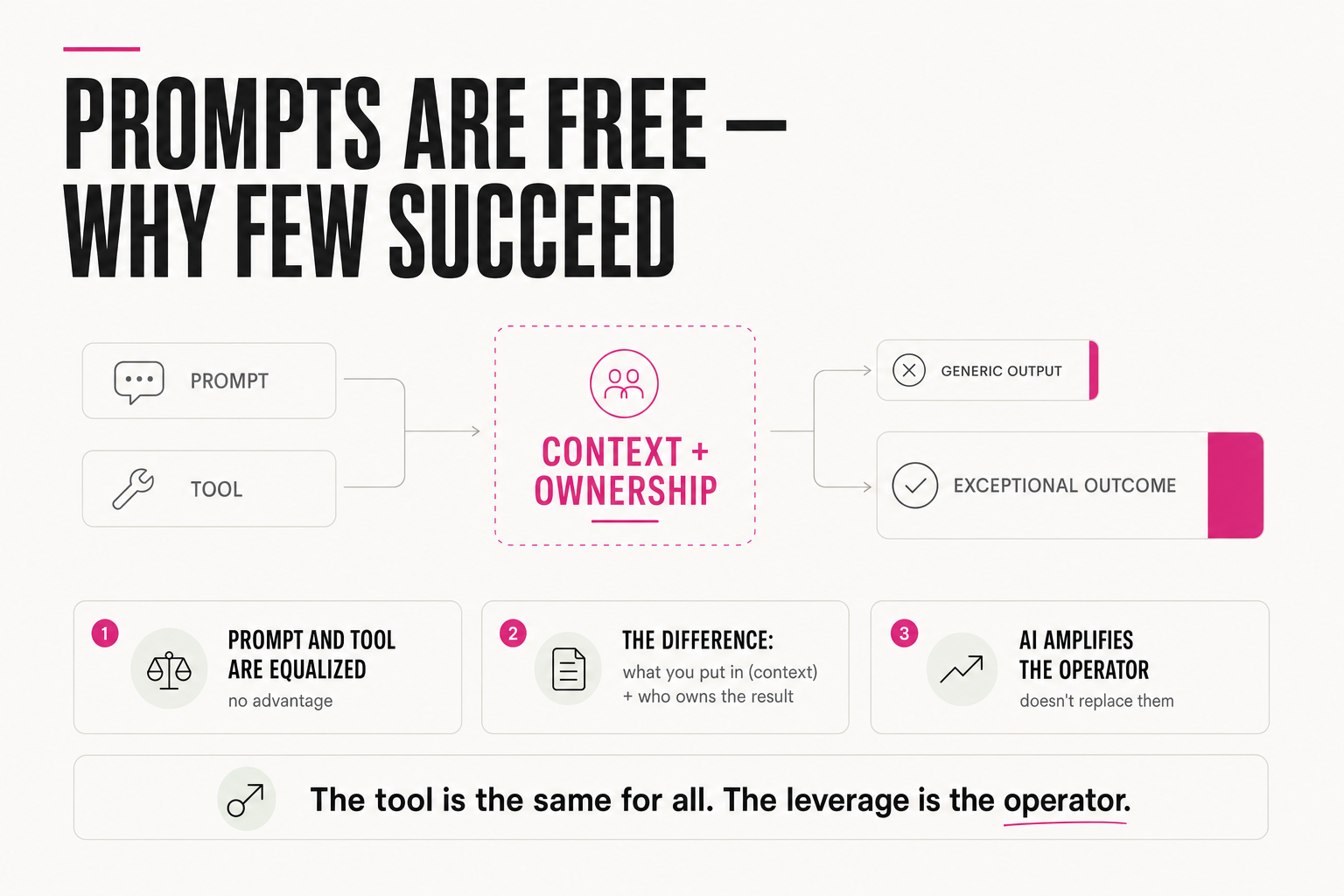
Put the two causes together and the picture is clear: the tool is the same for all, the leverage is the operator. Context fills the answer; ownership drives it to a result. The model amplifies whoever stands behind it: if there's something to amplify and someone to finish it — multiple growth; if it's empty — emptiness, only faster.
"I'll find the secret prompt / the best model" → the same as everyone's, the result doesn't move.
I put in my context + take ownership of the result → the same AI gives multiple growth.
The good news: both context and ownership aren't innate — they're grown. Which means the gap isn't fatal; it's crossable.
06 — Where to start
Where to start if "I have the tools but no results"?
Stop hunting the best prompt. Ask yourself two questions: what unique thing can I put into the model (experience, cases, voice) — and what role am I acting from, do I own the result or wait for "the tool to do it." The first question fixes context, the second fixes ownership.
Every day, write down: 1 task where AI gave you the average, and
what exactly you could have added (an example/criterion/number)
to make it not average.
After a week — 7 concrete gaps in your context. Close them once,
and it stops repeating.Prompts and tools are equalized — that's why they give no advantage. The advantage is you: what you put in and what you drive to a result. AI didn't make everyone successful because it amplifies the operator rather than replacing them.
FAQ
If everyone has the same prompts, why learn them at all?
A prompt is an entry ticket: it sets a direction but doesn't create the result. Worth learning to a basic level; beyond that the payoff drops. The advantage isn't in the phrasing, which can be copied, but in the context you put in and whether you drive it to a result.
Why does the same prompt give different people different things?
Because a prompt only directs, while your context (experience, cases, voice) fills the answer and a person drives it to done. Copying someone's prompt is easy, but not what's behind it. So with equal tools the results diverge — the difference is the operator.
What does "the part that takes responsibility" mean?
It's the role you act from and finish results from, rather than waiting for "the tool to do it itself." Example: a blog with no growth for five years moved to 24,000 followers in a month once the role that acts like a blogger was grown. The tools didn't change — the person behind them did.
If it's not the tool, is AI even needed?
It's needed — as a multiplier. It massively amplifies someone who has something to put in and who owns the result. But it amplifies rather than replaces: with empty context and no ownership, AI just produces emptiness faster. The leverage is the operator; the tool is the arm of the lever.