AI won't replace experts. It'll make some irreplaceable and others redundant
Why AI only multiplies what you already have — and 3 signs of whether it's amplifying your expertise or substituting for emptiness.

01 — The trick
What exactly are they selling you as freedom?
They're selling the idea that the tool cancelled the need to be good at anything. That the eye you built, the years of practice, the failures — all zeroed out, because now there's a box with a text field. It's a very convenient idea, and it hits the dopamine dead-on: you can know nothing and still "hire an automated AI team for $0."
The problem is that assembling a team with no resource of expertise — yours or someone's — is a fantasy. AI doesn't hand you competence. It hands you text that looks like the work of a competent person. Those are different things, and only someone with the competence sees the difference.
Marketers amplify the trick with "build an agent in 1 minute," "automate everything." It sounds like freedom from skill. It's really shifting the skill onto whoever already has it — and selling that as "magic" to whoever doesn't.
"Set up an agent in 1 minute, automate everything" → you get a tool that only knows what you put into it. And there's nothing to put in.
The same tool in the hands of someone with a ready method and criteria does in minutes what used to take hours.
02 — The machine
Why does the machine amplify rather than level?
To see the trick, look at how the model works — no mysticism. A large language model doesn't "know" the right answer and doesn't "think" about your task. It predicts the most likely next fragment of text given the context you gave it.
The key word is context. Answer quality is set not by the model's magic but by how precise, complete and well-bounded your input is. And the quality of that input is your expertise. Ask with "no context" and you get the most likely thing — the internet's average, a cliché. Give an expert input and you get an answer built around your specific task.
NO CONTEXT: "How do I raise my prices?"
→ generic advice at the level of an internet article

WITH EXPERT INPUT: "I run a B2B service, average ticket $8k,
raised prices twice in 2 years with no client loss via a
month-ahead email + a value explanation. Now I need another
20% increase. Draft the email in the same style that worked
before: [attach the past email]"
→ an answer you can use right away
The machine doesn't level the players. It widens the gap between those who have something to put in and those who don't.— Anjela Petkova
03 — The vulnerabilities
Where does a lack of expertise fail you?
When you tackle a task outside your field, the missing expertise hits at three concrete points — at every step of working with the model:
- You can't see the whole situation. To give correct context you first have to analyze the task correctly. Without experience you don't know what's signal and what's noise — so you feed the model an incomplete or distorted picture.
- You have no "worked / didn't work" patterns. An expert carries a map of winning and losing strategies. Without it you can't set the model's boundaries or cut off the obviously bad paths.
- You can't verify the answer. AI produces the plausible. Telling a working solution from a pretty mistake takes an eye. Without it, you accept the fake as a result.
Notice: none of the three is about a "weak model." All three are about what's missing on the input and on the check. The model just amplifies what you brought.
[ ] Can I describe the whole situation, not just what's on the surface?
[ ] Do I know at least 2 similar cases — one that worked, one that failed?
[ ] Could I tell a good model answer from a plausible but wrong one
    if I saw both?

0–1 "yes" → find an expert to check before acting
2–3 "yes" → you can use AI, but double-check the key decisions
04 — The multiplier
How much stronger is the multiplier when expertise is there?
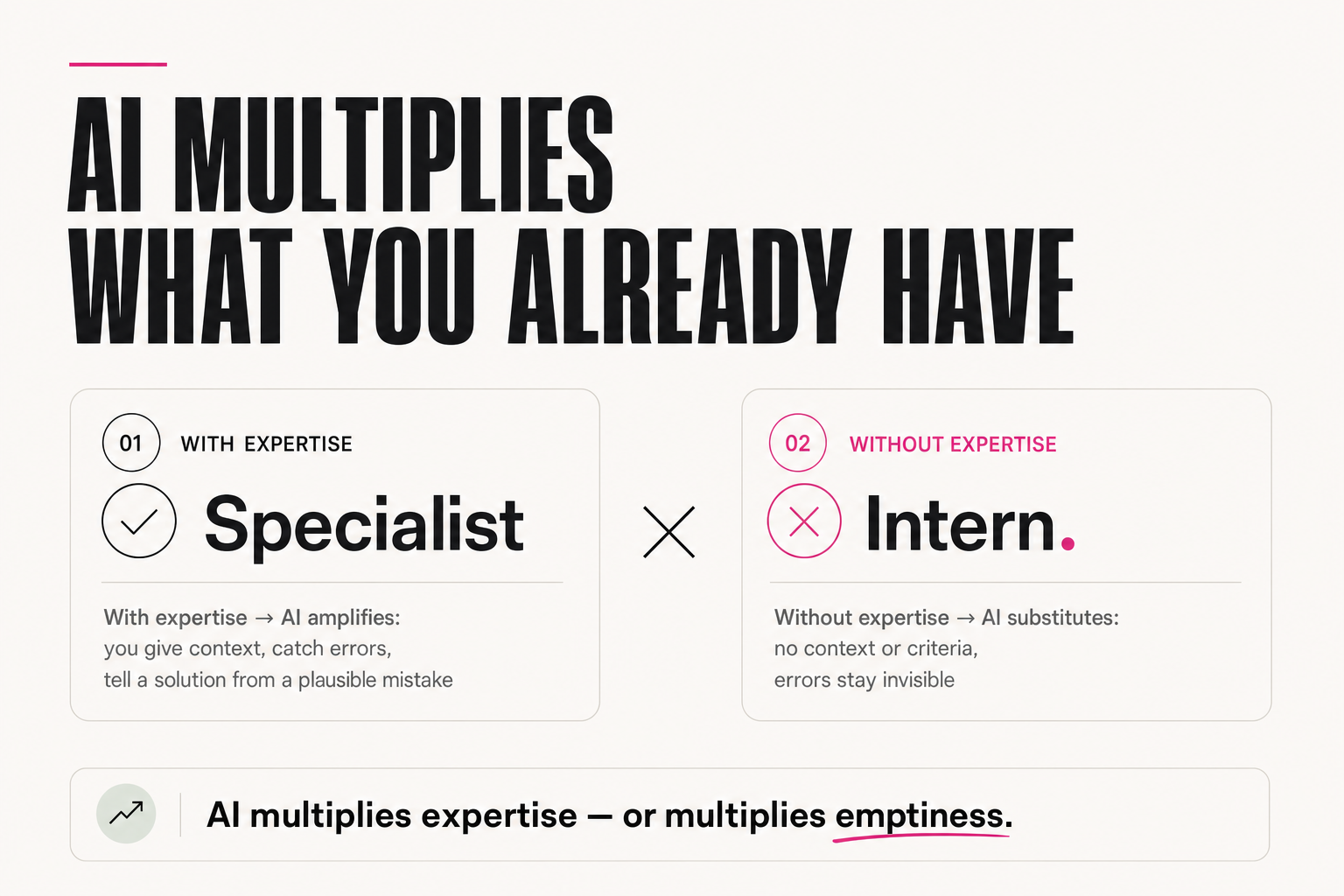
The trick only runs one way. If the expertise is there, AI becomes the most powerful multiplier you've had — and the gap is measurable.
One agency owner who tested this found that adding real examples when setting a task made the output roughly five times better. Same model, same task — only the expert input changed. At a conference an Amazon leader put the same thing in business terms: general models are identical for everyone; the competitive edge is your data. Anyone can say "write me an ad headline"; but with the results of hundreds of campaigns and an analysis of what worked behind you, the answer is a completely different thing.
"Write an ad headline" → a templated phrase anyone could have written.
"Here are 5 headlines that worked for me and 3 that failed — here's why" → a headline that lands with your audience on the first try.
Everyone's prompt is roughly the same — the models are identical. The difference comes from what you can put into the model and what you can check its output against. That's expertise.
05 — The fix
What should you do if you have the expertise?
The approach to expertise-heavy tasks isn't "write a better prompt" — it's moving into the model what normally lives only in a specialist's head:
- Give full context — not a one-line request, but the picture of the task you see as a professional.
- Set the constraints — your patterns of winning and losing decisions, the market frame, the limits of acceptable.
- Build the check — the criteria by which you yourself tell good from merely plausible, handed to the model as a checklist.
"Write a product launch strategy."
"Here's the audience, past launches with numbers, what worked and what failed, my criteria for a good strategy. Assemble a plan and flag risks against my red flags."
On the left you ask the model to be the expert instead of you. On the right you make it a multiplier of your expertise. The first is the trick. The second is leverage.
06 — In practice
How do you set this up to use every day?
Transferring expertise is one-time work, not a ritual per request. Assemble it once into a project or folder: your best analyses, your worked/didn't-work patterns, your check criteria, your frames. The model reads from there — and every answer starts at your level, not the average.
Then correct it. Each time the model gets something wrong, don't just fix the output — add the rule that would have prevented it. After a few rounds you stop prompting from scratch and start delegating to something that already knows how you think.
1. The model answered wrong → don't just rewrite it by hand
2. Ask yourself: what rule did I apply without saying it out loud?
3. Add that rule to the standing context ("never...", "always
   start with...")
4. Next time the model doesn't make the same mistake — verified
   across 3–5 correction loops on real tasks
That's when the promise the marketers wave around actually comes true — but honestly: not "AI instead of the expert," but "the expert, amplified by AI." That's the line that will separate the irreplaceable from the redundant in the coming years.
FAQ
Can AI replace an expert if I don't understand the task myself?
No. Without expertise you can't give the model full context, set correct constraints, or judge the answer. AI predicts the most likely answer — and easily misleads anyone who lacks the eye to tell a good solution from a plausible mistake.
Why doesn't one ChatGPT prompt replace a specialist?
Because a prompt is only the wrapper. A specialist's value isn't in the phrasing of the request — it's in the steps they go through, what they check first, where they stop. Without that, AI works at the level of the internet's average, however nicely the request is worded.
So AI is useless for a beginner?
No — but the role is different. For a beginner AI helps as a learning accelerator and a drafting tool, not as a substitute for judgment. The danger is taking its plausible answers for finished solutions. Until you have the eye, anything important needs checking by someone who does.
How do I tell if AI is amplifying my expertise or substituting for it?
By three signs: can you give full context, set your own constraints, and verify the answer? If all three are yes, AI is a multiplier. If even one is no, you're on the substitution side — and the result will be plausible but unverifiable.