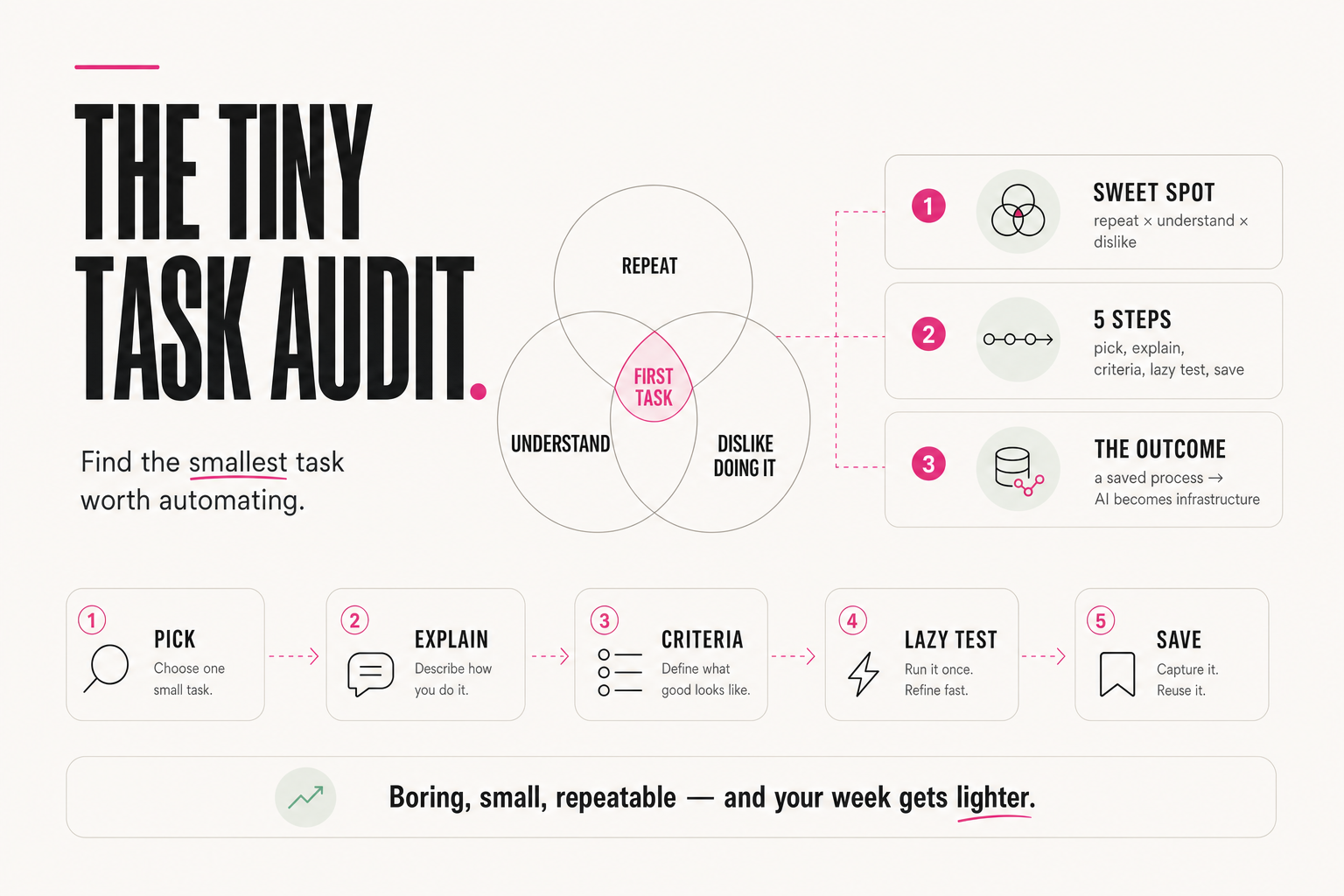
One action will bring you more than 1,000 AI experiments
Your brain is a collector: it wants to save prompts and try new things. Results come from boring focus on one task. A 6x growth case and the "explorer vs achiever" test.

01 — The diagnosis
Why does your brain sabotage your AI results?
What's the core problem of people who study AI but don't grow?
Your brain is a damn collector. It's wired to learn, absorb and try as much new stuff as possible. That's why we endlessly watch reels and save prompts. And it finds focusing on one thing genuinely hard.
Here's what I see in people who don't grow: they use AI as intellectual entertainment. No, you're not generating pointless images. But you're exploring: "what about this task? how about that one? let me try here?"
Exploring isn't bad. But there's a difference between exploring and results.
02 — The difference
How does an achiever differ from an explorer?
Tries AI on 30–50 processes, superficially. Saves prompts "for later." Six months on: piles of experience, a sea of impressions, and zero measurable change in money, time or metrics.
Picks one task. Sets metrics. Embeds AI into it until the result is measurable — and only then takes the next one. Six months on: 2–3 processes that genuinely work and pay.
What do the people who get results do? In my focus groups I always start with the most boring part: we set metrics, assess processes, understand the current state. People hate it — they want to jump to the fun stuff: prompts, experiments, magic buttons, and agents that "do everything themselves" (however badly).
But that boring first step is exactly what separates people whose AI works from people whose AI entertains.
03 — The case
What single-task focus delivers: 6x growth
Here's what happens when you put focus on one task.
I set a goal — grow the blog. Not study new AI tricks. Not experiment across tasks. One focus: using AI, make the blog grow — subscribers, reach, sales.
It grew six-fold.
Not the most surprising task. Not flashy. Not interesting… but effective. That's the whole point of focus: when you embed AI properly into one task, you get a concrete MEASURABLE result — time saved, income up, metrics improved.
A quality result in ONE process
brings more money than superficial
experiments across DOZENS of processes.
So instead of saving yet another prompt, ask yourself: which single task will I take to a measurable result with AI this month?
04 — The test
Are you an explorer or an achiever right now?
An honest self-diagnosis — four questions about your last couple of months with AI:
05 — The practice
How do you set a one-month focus?
Setting the focus takes 20 minutes, once a month:
- Picked ONE task with a measurable result (time, money, reach, leads)
- Wrote down the current number — the "before" point (the most boring and most important step)
- Stated the month's goal in one line: "use AI to take X to Y"
- New tricks and prompts pass one filter: "does this move my focus?"
- Weekly — 10 minutes: check the number, adjust
- End of month — an honest before/after and a decision: go deeper or take the next task
The "does this move my focus?" filter is the main defense against the collector: a trick either plugs into the current task or goes past you. Not "for later" — past. "Later" is the graveyard of saved posts.
The difference between "studying AI" and "AI works for me" isn't the number of prompts — it's focus. One task, a "before" metric, a month of proper embedding — and you get a measurable result instead of a collection of impressions. My one focus delivered 6x growth. What will yours be?
FAQ
What about breadth? Shouldn't I follow AI news?
You should — in doses and through the filter: "does this move my current focus?" Pattern literacy helps when it serves the task and hurts when it replaces it. A working ratio: 30 minutes a week for the new stuff — and a month of focus on one task.
How do I pick the task for my first focus?
Two criteria: the result is measurable (time, money, reach, leads) and the task repeats weekly — so the effect compounds. Classic candidates: content, application processing, reports, client correspondence. Don't pick the hardest — pick the most measurable.
Why does writing down the "before" number matter so much?
Without it, a month later you'll say "it feels more convenient" — and that kills motivation. The "before" number turns feelings into fact: 5 hours a week became 1.5; 200 views became 1,200. Facts are what convince you (and your team) to continue.
What do I do with the focus after the first result?
Two paths: go deeper on the current task (automate further, build an assistant) or take the next task with the same scheme — one task, a metric, a month. The second task always goes faster: you now have both the experience and the discipline of focus.