ChatGPT as your personal stylist: color season, body type and a wardrobe audit
Upload full-length photos and shots of your closet — get three boards: a type analysis, a wardrobe audit, and a list of what to buy. Prompts inside.
01 — From face to closet
How does appearance analysis turn into a wardrobe audit?
It started with the appearance-analysis trend. The logical next step is to audit the wardrobe (right on time for a spring closet revision). The plan is simple: upload ordinary full-length photos and shots of your items, and ask for three boards: a type analysis, a closet audit, and what to buy.
The output isn't "wear blue" but glossy-grade mood boards: Kibbe body type, color season, archetype, which silhouettes work, which items to keep and which lead you astray. Below are the three prompts that build it.
☐ A portrait and a full-length photo, no filters or retouching
☐ Even light, your real shape visible (no baggy clothes)
☐ Wardrobe items one by one, on a plain background, fabric visible
☐ Don't mix items from different seasons in one batch of photos
02 — Type analysis
Prompt 1: appearance, color season and body type
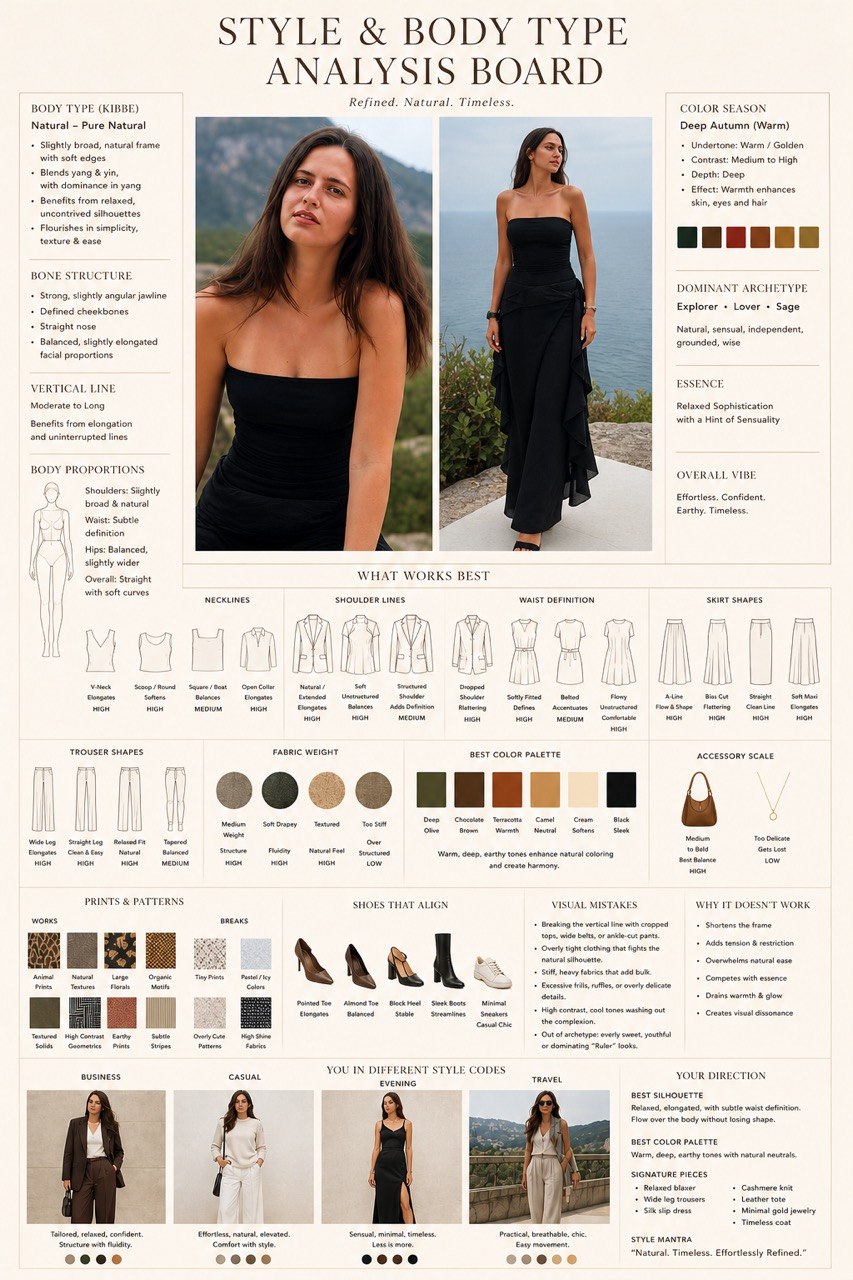
The first prompt builds the type board: Kibbe, color season, archetype, silhouettes, palette, mistakes. Copy it as is (English — the model is more accurate that way), attaching a portrait and a full-length photo:
Create a high-end editorial "Style & Body Type Analysis Board" using this portrait and full-body photo. Luxury fashion magazine style, clean beige/ivory background, warm tones, soft diffused lighting, photorealistic, minimal typography, grid layout.
Center the natural portrait and full-body shot (no retouching, real skin, same face, same proportions).
Add analysis: body type (Kibbe — dramatic/natural/classic/gamine/romantic + subtype), bone structure, vertical line, proportions (shoulders/waist/hips), color season (undertone, contrast level), dominant archetype.
Show silhouettes that work: necklines, shoulder lines, waist definition, skirt and trouser shapes, fabric weight. Each: construction + short note (elongates/balances/softens) + harmony level (high/medium/low).
Then: best color palette (4–6 swatches with effect on face), prints that work vs break the type, accessories scale, shoe shapes.
Add: visual mistakes (proportion breaks, wrong fabric weight) + why.
Final: "you in different style codes" (business / casual / evening / travel) + clear direction (best silhouette, palette, signature pieces).
03 — Wardrobe audit
Prompt 2: wardrobe audit (keep / remove)
The second prompt takes photos of your items and gives a verdict on each — tied to your type, not to abstract fashion:
Create a visual "Wardrobe Audit Board" using photos of my wardrobe and this portrait. Luxury editorial style, ivory background, photorealistic, minimal typography, grid layout.
For each garment give a verdict: KEEP / QUESTION / REMOVE — with a color tag. Show the item + a small render on my body type + one-line reason tied to my type, season or archetype (not generic fashion).
Highlight HERO PIECES — items that work at maximum — in a separate row with a gold accent.
Identify the systemic pattern: what I keep over-buying that doesn't suit me. One sentence diagnosis.
The most valuable part is the "systemic pattern": one sentence on what you keep over-buying for nothing. That's an insight a normal try-on never gives.
04 — What to buy
Prompt 3: what to buy (with priorities)
The third prompt finds the gaps in your wardrobe for your type and lifestyle and suggests what to buy — with priority and price tier, plus a "do not buy" row:
Create a visual "Wardrobe Gap Analysis Board" using photos of my wardrobe and this portrait. Luxury editorial style, ivory background, photorealistic, minimal typography, grid layout.
Map what I already have (silhouettes, palette, style codes). Then find the GAPS based on my Kibbe type, color season, archetype and lifestyle.
For each missing item show: photorealistic render (silhouette, fabric, color), the gap it fills, 2 outfits with items I already own, priority (ESSENTIAL / STRONG ADD / NICE TO HAVE), price tier (investment / mid / mass-market).
Add a "do not buy" row: 4 items that would duplicate what I have or conflict with my type.
Final: before/after — current coverage vs full coverage. Visual-first, short labels.
Three boards in a row give what you'd usually pay a stylist for: type → what to keep → what to buy, in one logic and tied to your real items.
05 — Will it replace designers
Will this replace stylists and designers?
When I showed these boards to a graphic-designer friend, she said it "laid them out well" — and that she's done for. The honest answer: not done, but shifting. AI covers the first systematic pass — layout, structure, running through options — what used to cost time and a consultation.
AI laid the board out well — and that's scary. But it covers the first pass, not taste, the trained eye and the final decision.— Anjela Petkova
What stays with the human: taste, life context, exceptions, fine-tuning to the real you. AI amplifies the stylist and the designer and gives the client an accessible start — but it doesn't cancel the person who takes the look to a result.
1. The board said "remove" an item you're emotionally attached to —
   that's your call, not the board's.
2. Your lifestyle changed (a move, a new job) — the board doesn't
   know that until you tell it.
3. Two options are equally "harmonious" on the board — the choice
   by personal taste is still yours.
06 — How to use it
How do you get accurate boards, not generic ones?
The rules are the same as for appearance analysis:
- Full-length, filter-free photos + clear shots of items, ideally one by one.
- Prompts in English — more accurate for this scenario.
- Go in order: type first, then the audit, then what to buy. Each board builds on the previous one.
- The decision is yours: a board is a direction and arguments, not a verdict on your closet.
Run "what to buy" first, with no type analysis →
you get a generic "basic wardrobe for anyone" list.
Run them in order (type → audit → buy) →
the shopping list accounts for your actual proportions and palette.Three prompts turn ChatGPT into a personal stylist: type and color season → wardrobe audit → what to buy, all tied to your real items. It's the first systematic pass that used to cost a consultation; taste and the final word stay with the human.
FAQ
What photos do I need for a wardrobe audit?
A portrait and a full-length photo without filters (for type and color season) plus clear shots of items, ideally one by one. The more honest the input, the more accurate the board: the model ties verdicts to your real proportions and palette, not to abstract fashion.
What are Kibbe and color-season analysis in these prompts?
Kibbe is a body-type classification (dramatic/natural/classic/gamine/romantic and subtypes); color season is your undertone and contrast level. The prompt asks the model to determine them and derive suitable silhouettes, palette and items from that. It gives a systematic logic rather than scattered tips.
Will ChatGPT replace a stylist?
It covers the first systematic pass — type analysis, audit and a shopping list, which used to cost a consultation. But it leaves taste, life context, exceptions and fine-tuning to the human. AI amplifies the stylist and gives the client an accessible start; it doesn't cancel the specialist.
In what order should I run the three prompts?
In sequence: first the type and color-season analysis, then the wardrobe audit (keep/remove), then what to buy. Each board builds on the previous one: without the type, the audit and shopping list would be generic rather than tailored to you.