ChatGPT as your makeup artist: analyze your look from a photo — hair, makeup, skin
The "appearance analysis" trend turned out more accurate than you'd expect. Here are the working prompts ChatGPT uses to build a board with hair, makeup and skincare.
01 — The trend
What can ChatGPT's "appearance analysis" actually do?
OpenAI shipped a strong image-generation update, and the "appearance analysis" trend caught on for a reason: the accuracy genuinely surprises. The logic is simple — you upload your photo and ask the model to build a visual board: analysis of your features, what suits you, what doesn't, and concrete recommendations.
The output isn't a wall of text but a laid-out mood board: face proportions, best hairstyles, what to avoid, a color palette, capsule looks. Below are four prompts that build it. One rule for all: attach clean photos with no makeup and no filters, or the analysis goes off.
☐ No makeup (or as minimal as possible)
☐ No filters or retouching
☐ Even daylight, face straight-on
☐ Hair pulled back so features and face shape are visible
☐ A separate full-length shot if you want a hairstyle analysis
02 — Hair
Prompt for hair and face-shape analysis
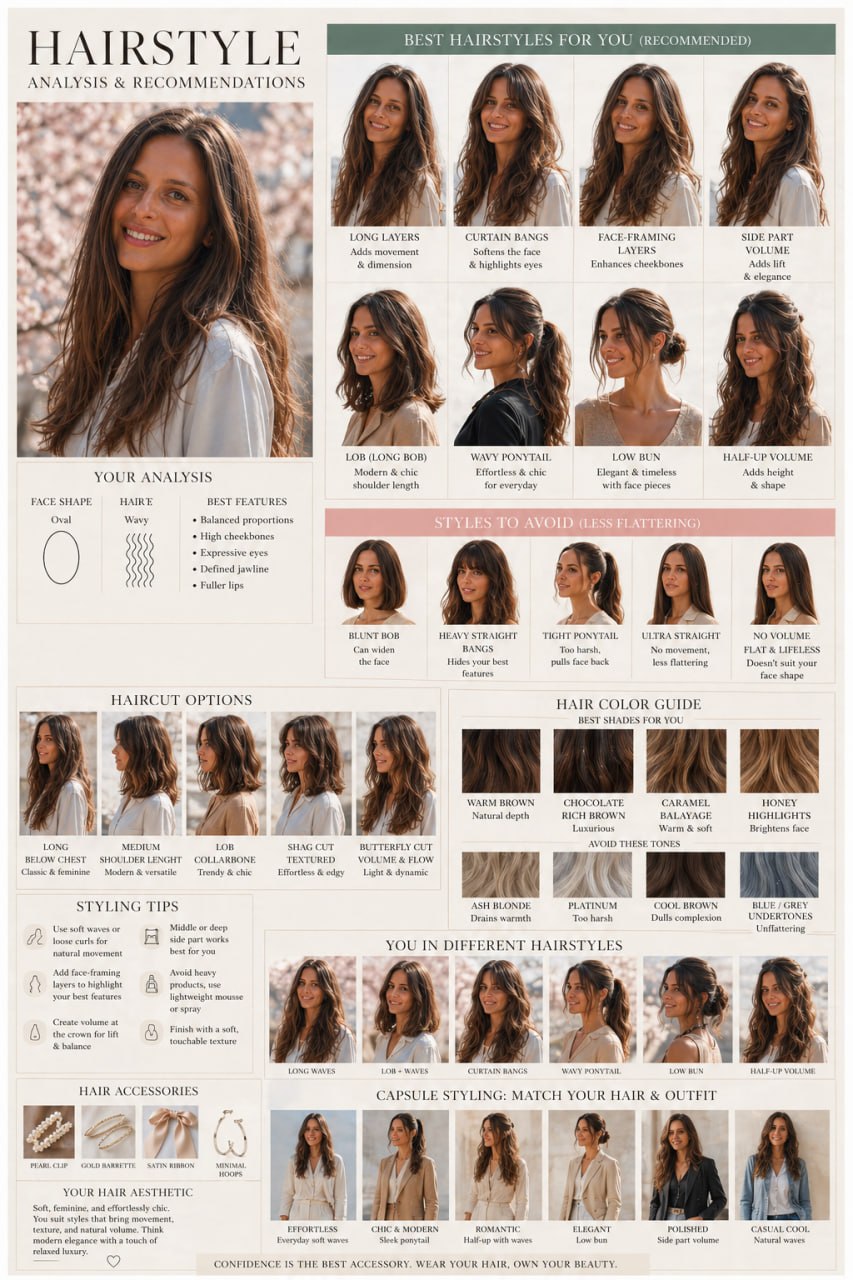
The first and most striking prompt analyzes the face and matches hairstyles with structure and a harmony level. Copy it as is (it's in English — the model is more accurate that way):
Center the natural portrait (no retouching, real skin, same face).
Add analysis: face proportions, bone structure, key features, symmetry + hair (density, texture, movement). Define balance: where to add/soften volume.
Show haircuts as structure: layers, blunt/U/V shapes, face-framing, bangs (or none), bob, shag, solid vs textured, different lengths. Each: clear construction + short note (elongates/widens/softens) + harmony level (high/medium/low).
Then styling: waves, sleek, blowout, buns, ponytails, etc. — show how styling supports or breaks the haircut.
Add: visual mistakes/effects (heaviness, flatness, imbalance) + why, color (warm + alternative tones, effect on structure), styling principles (volume, movement, parting, finish).
Final: "you in different looks" (capsule styles) + clear direction (best haircut type, styling, color).
03 — Makeup
Makeup prompts: what suits you and how to apply it
Next, two makeup prompts. The first asks for recommendations (what makeup suits your face), the second for a step-by-step application scheme. Both require a clean photo with no makeup and no filters.
The application-scheme prompt is the most practical — it draws where to put contour, highlight, blush and brows:
Create a full scheme on where to apply for the contour, highlight, blush and brows to get that result, and the same for the eye, if we want to make a medium eye makeup, where and how to apply to get the amazing result that we have here.First ask for recommendations, then for the application scheme of the option you chose. That way you get not an abstract "nude suits you" but a map: where and what to apply to repeat the result.
04 — Skin
Prompt for skin analysis and skincare
The fourth prompt is a visual skin analysis: type, problem areas and what to do about them (skincare, routine, tools). Again — a clean photo with no makeup and no filters.
Create visual analysis of my skin, my skin type, what problems do I have in which areas, and what to do with that to fix it — skincare, routine, biohacker tools and etc.It's a fast, honest start, not a diagnosis. Serious skin issues — see a dermatologist; AI is good as a first map, not as a doctor.— Anjela Petkova
05 — How to use it
How do you get an accurate result, not mush?
Accuracy depends on the input — as always with AI. A few rules so the board lands instead of going generic:
- A clean photo, no makeup, no filters — otherwise the model analyzes the filter, not you.
- Good even light, a front-facing portrait — for hair you can add a full-length shot.
- Prompts in English — the model is more accurate for this scenario (as in the example).
- Treat it as a recommendation, not a verdict: the board shows direction, the decision is yours.
And remember: ChatGPT here isn't a replacement for a makeup artist or dermatologist, but an accessible first step that used to cost a consultation.
"What suits me?" → a vague compliment with no specifics you can actually act on.
Proportions + bone structure + volume balance + a harmony level per option → a systematic breakdown you can see on the board.
06 — Why it works
Why does a model pull off this kind of analysis at all?
The reason is the same as with everything else in AI: the quality of the answer is set by the quality of the input. A clear photo plus a structural prompt that asks not "rate me" but for concrete axes (proportions, bone structure, volume balance, harmony of options) — and the model produces a systematic breakdown rather than a compliment.
Don't ask for a one-word verdict ("pretty?", "does this suit me?").
Ask for a breakdown by axes: exactly what to look at, by what
criterion, how to compare the options against each other.
The same principle works beyond appearance — for design,
presentations, any visual material."Appearance analysis" works not by magic but through prompt structure and a clean photo. Four prompts — hair, makeup recommendations, application scheme, skin — give you a finished board. It's a start, not a verdict: the final word is yours and, where needed, a specialist's.
FAQ
Why are the prompts in English if I write in Russian?
For this scenario the model handles the structural analysis more accurately in English — that's how the examples in the post were produced. You can ask in Russian too, but English prompts give a more predictable board. Just copy them as is and attach your photo.
What photo should I attach?
A clean one, no makeup and no filters, in even light, a front-facing portrait. For hairstyle analysis you can add a full-length shot. If you attach a filtered or made-up photo, the model analyzes that rather than you, and the recommendations go off.
Can I trust ChatGPT's skin analysis?
As a first map — yes: skin type, problem areas, a basic routine. But it's not a diagnosis or a replacement for a doctor. Serious issues (acne, pigmentation, reactions) — see a dermatologist. AI is good for getting oriented fast and asking a specialist sharper questions.
Will this replace a makeup artist and stylist?
No, but it covers the first step that used to cost a consultation: a fast structural breakdown and a direction. Final decisions and complex cases are for a human. AI here is an accessible assistant, not a verdict.