Why one post got 18M views in 7 hours — and where AI fits in
Virality isn't luck — it's patterns. The 7 rules that make content land in any niche, and where AI amplifies them.
01 — Not luck
Is virality luck or a pattern?
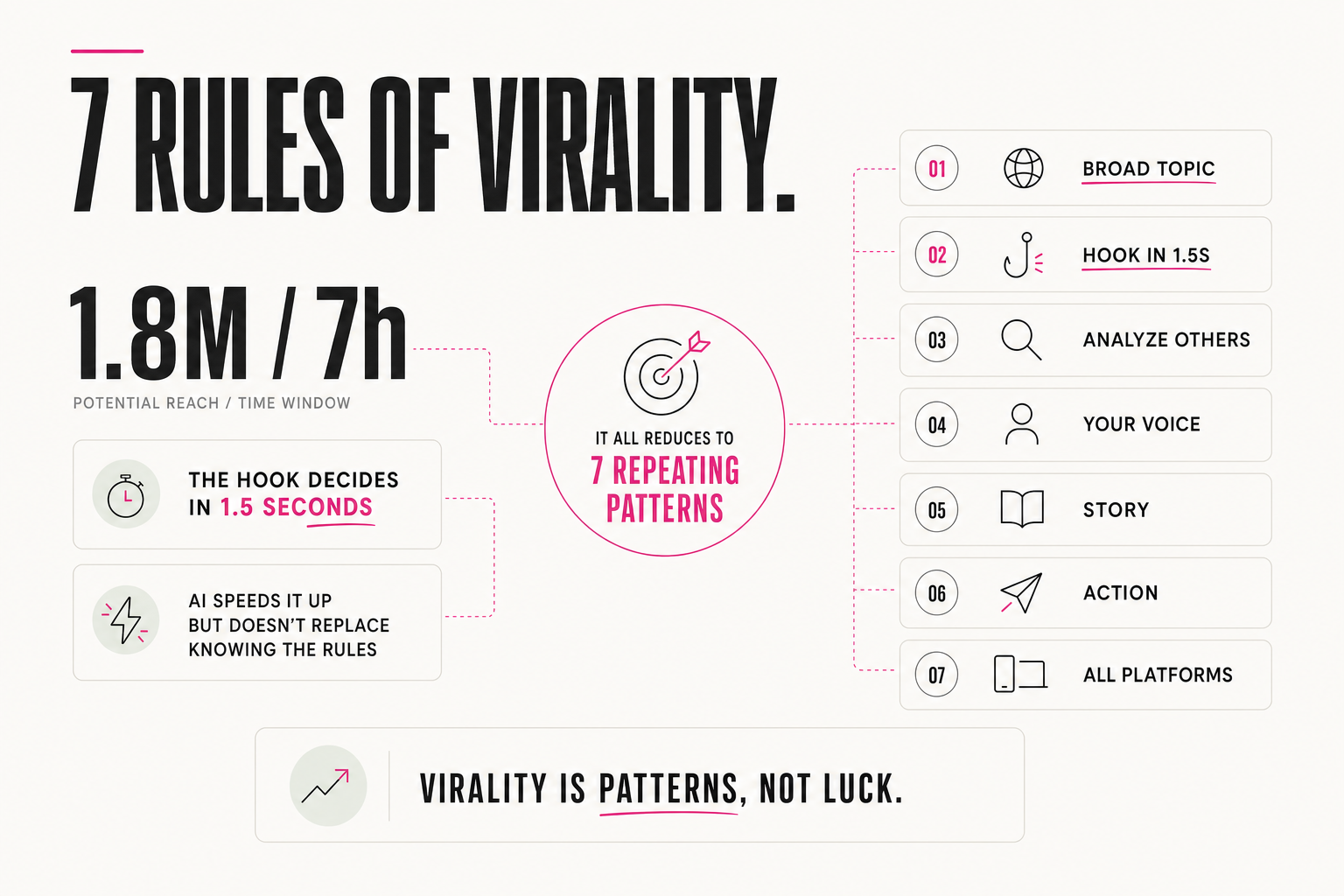
One day I woke up famous in Hong Kong: one of my Threads posts got reshared into big communities and pulled about 1.8M reach in 7 hours — I found out when people started sending me screenshots. It wasn't the first. Over a year of experimenting with virality, hundreds of posts landed — for me and for people who trusted me — and I grew 70,000+ followers from zero accounts.
Here's what I learned: posts that land share patterns. The same idea can get 500 views or 100,000. Virality looks random because people don't analyze it. Take 20 viral posts, break them down, and you'll see the patterns. Below are seven that repeat.
For each of your last 5 posts, check ✓ if it has:
☐ a broad topic (many recognize it, not a narrow segment)
☐ a concrete hook with a number/detail in the first line
☐ a story or example, not just a claim
☐ a call to action at the end
Posts with 3+ ✓? Compare their reach to posts with under 2.
02 — Rule 1
Why do broad topics land and narrow ones don't?
A narrow topic is a post for a specific segment in specific circumstances. A broad one is about a pain a huge mass of people recognize. Almost any topic can be widened to a universal pain, and the result changes tenfold:
"5 negotiation techniques for B2B SaaS sales"
"Investment strategy for a 10M+ portfolio"
"What to do when they tell you it's expensive"
"Why you don't save money even when you earn well"
The angle changed — reach grew tenfold. Same topic, but now a mass of people see themselves in it, not five.
03 — Rule 2
Why does the first line decide everything?
A feed has a hundred posts; yours is one of them. The brain decides in 1.5 seconds: "is this about me or not?" If the first line gives no clear signal, they scroll on. A hook isn't decoration — it's the entry ticket.
"Today I'll talk about delegation"
"Let me share how I budget"
"I lost $2,500 because I was afraid to delegate"
"I earned well and lived in debt. Here's what I changed"
The difference is specificity, stakes and tension. A weak hook describes the topic; a strong one promises a story with consequences that the reader sees themselves in.
04 — Rules 3–5
What separates a recognizable author from a faceless one?
Three rules that make content yours, not average:
- Analyze others' viral content. Break down what lands for creators in your niche, which patterns repeat. Virality stops being a lottery once you see its mechanics.
- Your own voice. It's not the "correct experts" who get known but those with a voice: how you speak, which examples you use, the lens you look through, your experience beyond the topic.
- Storytelling. The brain remembers sequences of events, not facts. Any idea can be delivered through a micro-story.
"You need to prioritize properly."
"I worked 12-hour days, proud of my productivity. Until I woke up and couldn't get out of bed. Diagnosis: burnout, four months to recover. Here's what I learned about priorities."
05 — Rules 6–7
What do you do with the views so they aren't empty?
Two rules that turn views into results:
- Action. A viral post with no funnel is empty views. They've read it, there's interest and trust — the perfect moment for an action: most often, asking them to comment a keyword in exchange for promised value. It works without fail.
- Scale to every platform. Turn a Threads post that hit 10k into a carousel, then a reel. Even if each version gets 2k, together it's more than one platform. And you test different hooks along the way.
Content lands by this structure in any niche — knitting or investing alike. The seven rules aren't about the topic, they're about the packaging.
"If you want [a concrete benefit — a guide/template/breakdown],
comment the word '[keyword]' — I'll send it to your DMs."

Why it works: interest already exists (they read to the end),
the threshold is low (one word), and you get a contact for
the funnel that follows.
06 — Where AI fits
Where does AI speed things up, and where won't it save you?
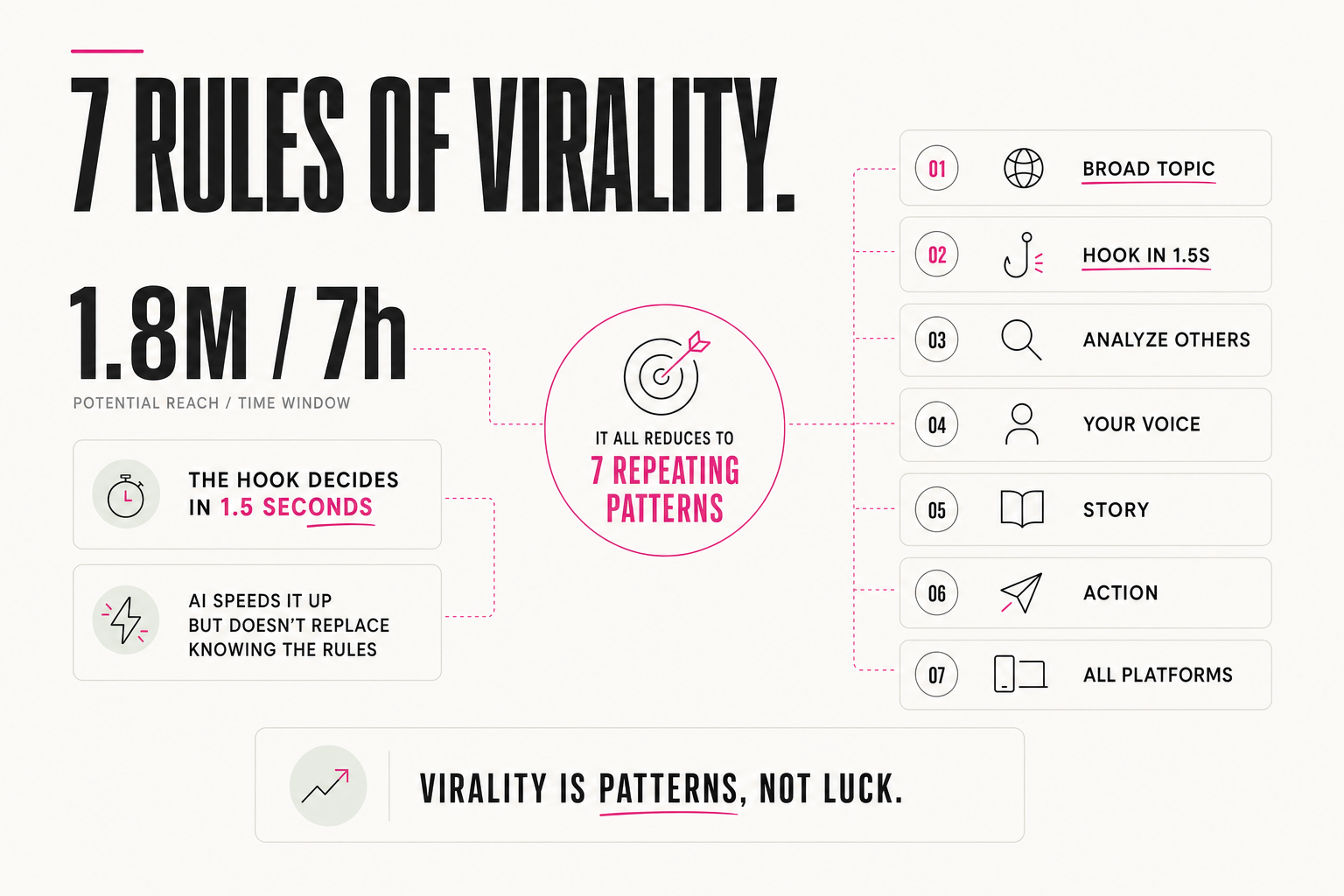
AI speeds the routine enormously: it drafts dozens of hook variants in 10 minutes, widens a narrow topic into a broad one, repackages a post for three platforms. That saves a ton of production time.
But there's a line. The model will spit out a thousand variants in a minute — and if you don't know the selection criteria, you'll pick the "pretty, correct" one rather than the one that actually grabs. AI amplifies the person who understands the rules and replicates mediocrity for the person who doesn't.
Here's my topic: [describe it].
Generate 15 hook variants. Then filter them yourself by 3
criteria: 1) has a concrete number/detail, 2) has stakes
(what's lost/gained), 3) doesn't sound like a topic overview.
Keep only the ones that pass all three, and explain why.First learn the seven rules — broad topic, hook, analysis, voice, story, action, scale. Then bring in AI as an accelerator. In that order it multiplies tenfold; in reverse it just produces average content faster.
FAQ
Can virality really be repeated rather than just lucked into?
Yes. Posts that land share repeating patterns — broad topic, strong hook, your own delivery, a story, an action. Break down 20 viral posts in your niche and you'll see the patterns. Luck affects a specific peak, but hitting the rules raises your baseline from hundreds of views to tens and hundreds of thousands.
What matters most in a viral post?
The combo of "broad topic + hook." The topic decides whether a mass of people see themselves in it; the hook decides in 1.5 seconds whether they read at all. A weak hook kills even a great topic. A strong hook is specificity, stakes and tension, not "today I'll talk about…".
Can AI write viral posts for me?
AI speeds things up beautifully: it drafts hooks, widens topics, repackages for platforms. But without knowing the criteria you'll pick the "pretty" variant, not the gripping one. AI amplifies the person who knows the rules; without them it just produces average content faster.
Does this work in a boring or narrow niche?
Yes — thanks to the broad-topic rule. Almost any narrow topic can be lifted to a universal pain: "B2B SaaS negotiation" → "what to do when they say it's expensive." Content lands by this structure in any niche, from knitting to investing.