Why smart people freeze at "so, what do you do?" — and the prompt that fixes it
"A transformation coach integrating subconscious patterns" — and glazed-over eyes. Let's build an intro that makes people say "oh, I need that!"

01 — The pain
Why do experts fail the simplest question?
At an event yesterday, a woman spent 5 minutes explaining she's "a personality transformation coach working through the integration of subconscious patterns"… And I still don't understand what she does or how she could help me 😅
And you know what? I was the same. I used to start: "I'm an AI specialist, we do prompt engineering, transferring human expertise onto machine learning systems…" — and watched people's eyes glaze over at the word "prompt." (Every time I wanted to finish with "I'm just a marketer.")
The paradox: it's precisely smart people who freeze on this question — the deeper the expertise, the harder it compresses, and the stronger the pull toward jargon. The cost is high: the biggest resources and opportunities come to us through "random" people. If we can't simply explain what we do, we lose them every single day.
02 — The secret
What does the other person actually want to hear?
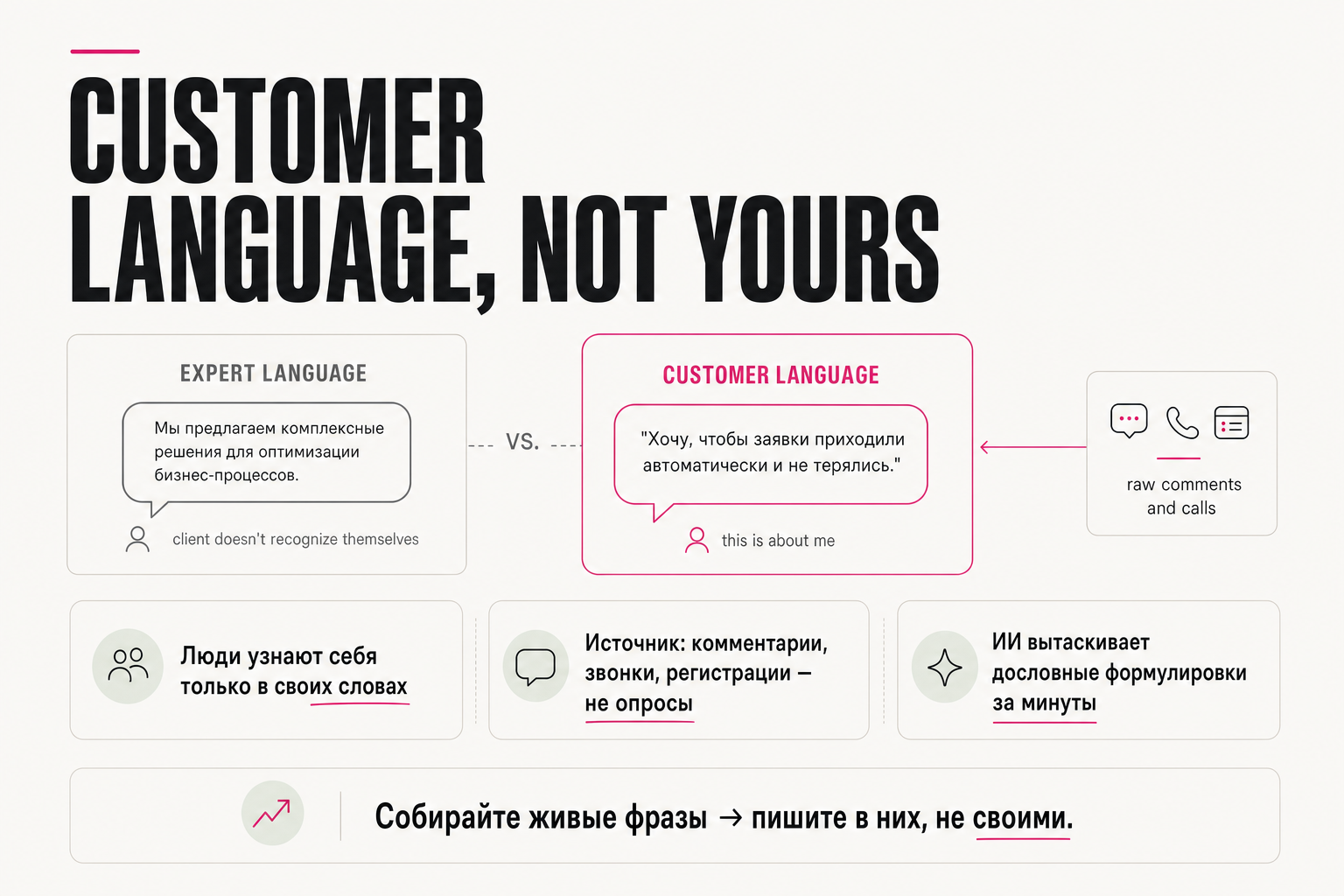
Then I remembered the secret: people don't want to know WHO you are. They care about exactly one thing: "what's in it for me?"
And it works far beyond introductions — in posts, decks, websites, profile bios. The rules of the game are simple:
- forget "I'm a coach / marketer / expert";
- talk only about what the person ACTUALLY gets;
- think like a client, not like a specialist.
"I help businesses grow." "I'm a relationship communication coach." "I'm a fitness trainer."
"I turn management chaos into systems that grow without you." "I teach you to talk to your partner so you're finally heard." "In 3 months you'll fit into the jeans that have hung in your closet for 2 years."
Feel the difference: in the second case the brain instantly draws the picture of the result. The intro's job is to make someone think "wow, I definitely need that" and want to know more.
03 — The prompt
How do you build your introduction in 10 minutes?
Rewriting your own intro is nearly impossible — you're inside your expertise. So we work through an interview with ChatGPT. The prompt in full:
I want a living introduction of what I do and the results it
brings, in 2 paragraphs — no pathos, no clichés.

Ask me questions:
- What problems do I solve?
- Who comes to me, and with what?
- What hurts my clients?
- What becomes easier with me?
- Why does this matter to me?

Style: the way I'd tell a friend over coffee. Warm, irony is
fine, but no "expert" pathos. Focus on the benefit, not on
empty credentials.

Example swaps:
Instead of "I help businesses grow" →
  "I turn management chaos into systems that grow without you"
Instead of "I'm a communication coach" →
  "I teach you to talk to your partner so you're finally heard"
Instead of "I'm a fitness trainer" →
  "in 3 months you'll fit into the jeans that have hung in your
  closet for 2 years"

The goal: the person thinks "wow, I definitely need that"
and wants to know more.
Answer the questions at length and in ordinary words — the way you'd tell a friend. Leave the jargon at the door: the model assembles the intro from your answers, and if "pattern integration" goes in, it comes back out.
04 — The generator
Scaffold your pitch right here
Want a quick draft before the interview? Fill in four fields:
The generator draft is a starting point. The full version via the section 03 interview always comes out livelier, because the model extracts details you'd never think to mention.
05 — The check
How do you verify your introduction works?
Test your current intro — the one you say at events or keep in your bio:
People don't want to know who you are — they want to know what's in it for them. A benefit-formula introduction takes 10 minutes with the interview prompt — and then works everywhere: meetings, bio, website. Run yours through the test above — and rewrite it before the next "random" person walks past.
FAQ
Why can't I just state my job title?
Because a title answers "who are you," while the other person is asking "what's in it for me." "Fitness trainer" is a category; "in 3 months you'll fit into the jeans that hung in your closet for 2 years" is a picture of a result. Brains latch onto pictures, not categories.
Isn't this too "salesy" for a normal introduction?
The formula isn't about selling — it's about clarity: you explain the benefit in the person's words instead of guild jargon. The style is fixed in the prompt — "like telling a friend over coffee, warm, no pathos." What makes intros salesy is pressure, and there's none here.
I have several directions — which do I talk about?
Pick the direction that fits the listener — or formulate the shared result that unites them all. Tell the interview prompt directly: "I have three directions; help me find the common denominator of benefit." The universal wall-of-everything intro performs worst of all.
How do I rehearse the intro until it's automatic?
Ask the model to play the stranger: "You're someone I just met at an event. I'll introduce myself — ask a follow-up or say what's unclear." Three or four rounds and the phrasing is road-tested. The final check: say it out loud in under a minute, no notes.