Speak your customer's language, not your own: why your copy falls flat
You write in expert language — and the client doesn't recognize themselves in it. Where to get their exact words and how AI extracts them in minutes.
01 — Why it misses
Why does your copy fall flat even when it's correct?
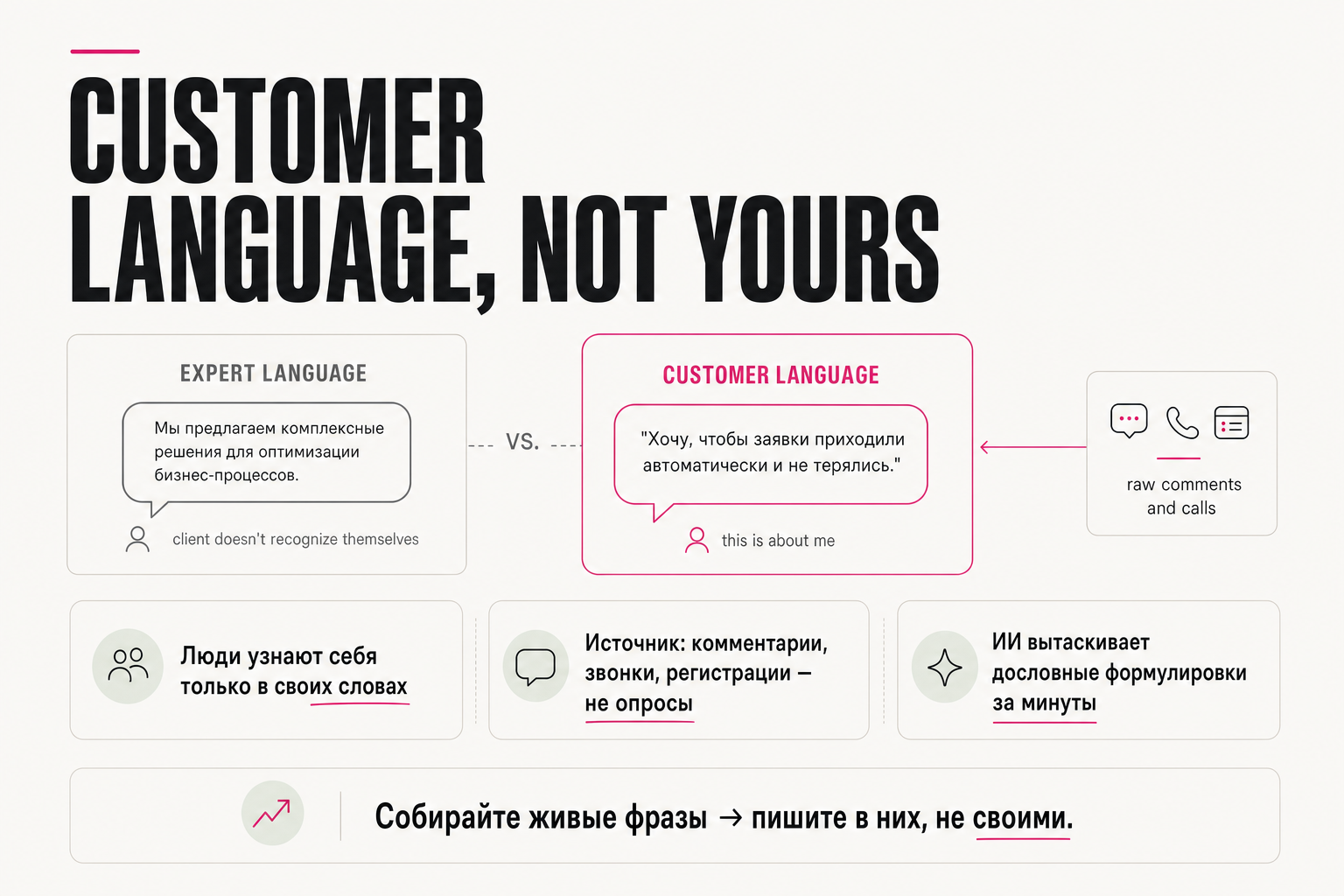
You write well, to the point, with expertise — and there's no response. A common reason: you write in your language. An expert describes the problem the way they see it after a thousand cases; the client names that same problem in completely different words. And in your "correct" description, they don't recognize themselves.
People respond to their own phrasings. When someone sees the exact phrase they think about themselves, the "this is about me" clicks — the very thing that makes them keep reading and trust you. So strong copy starts not with what you want to say, but with the words the client would use to say it.
Take your last post's headline and ask:
1) Did I use a term I know but my client doesn't?
2) Could the client say this phrase themselves, in their own words?
3) Is there a concrete situation here — or an abstract benefit?
2+ "no"s? That's expert language. Go find quotes in section 03.
02 — The rule
What's the rule "write in their language, not yours"?
Look at how real people phrase their tasks — verbatim, not polished marketing:
"Optimizing content production and cross-posting for multi-channel presence."
"I want to write alive posts that don't look like typical ChatGPT-ish text." "I'm the shoemaker with no shoes: I never have time for my own blog."
The right column is what someone recognizes instantly. "Finally learn to make viral content, for crying out loud," "I'm lost in how many chats I have" — phrases like these land more precisely than any invented example. The rule: write in their language, not yours.
03 — Where to get it
Where do you get the audience's exact words?
Not in surveys and not from your head. In living speech, where people don't pick the "right" words:
- Comments — what people specifically write under posts, what questions they ask.
- DMs and messages — how they phrase a request in their own words.
- Calls and transcripts — where a person explains the problem as naturally as possible.
- Registration answers for a webinar, challenge, or freebie — living speech, not a form.
Living speech specifically, not a poll: on a form people tidy up their phrasing, but in a comment or on a call they say it as it is. Those "as it is" phrases are your gold.
1. Open the last 20 comments under your posts
2. Write down the ones where someone describes THEIR problem
   (not praising you)
3. Find 3 DMs where a request is phrased in their own words
4. Collect it all into one list — that's your starter phrase bank
04 — AI's role
How does AI pull out the customer's language?
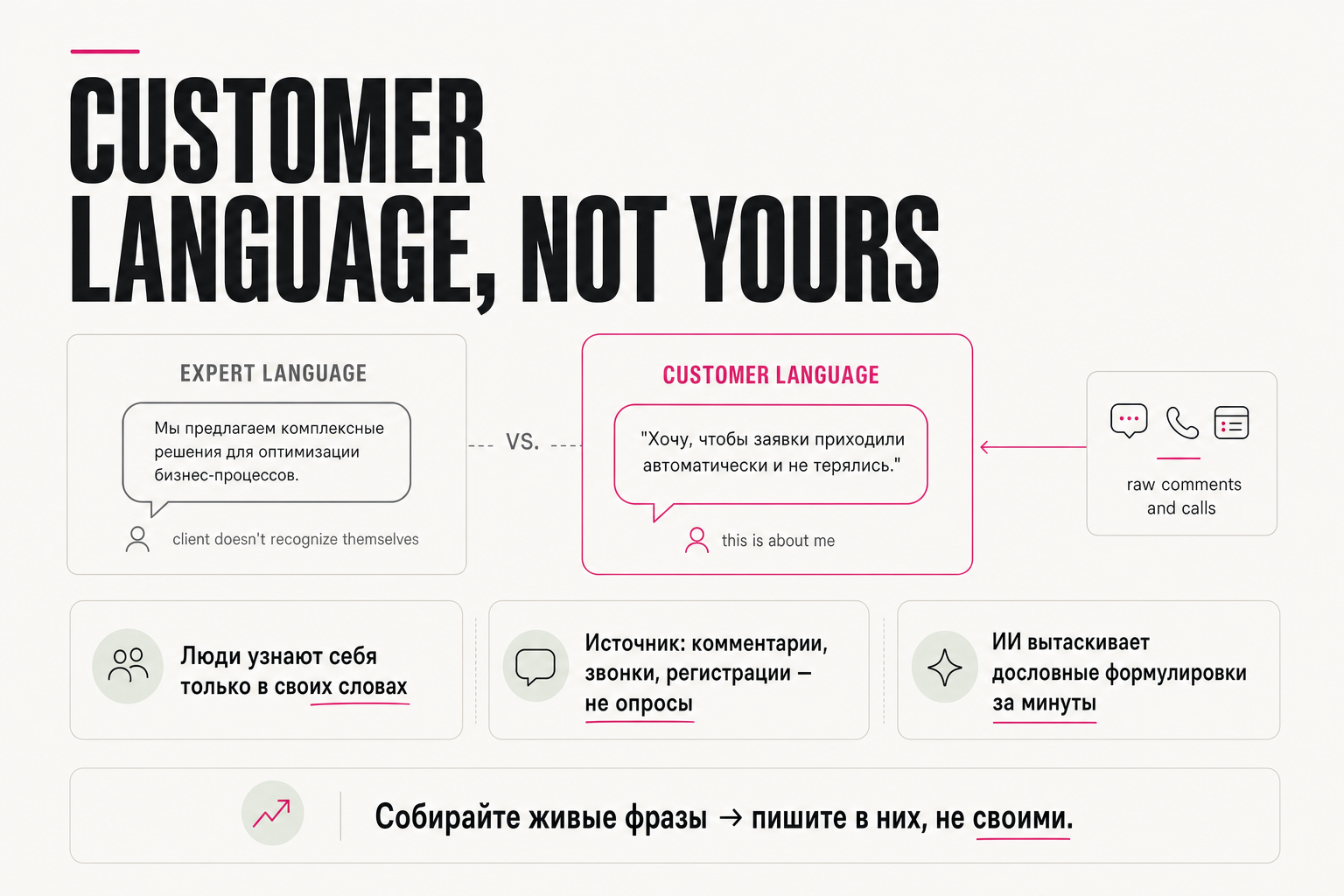
This used to be manual work — copying phrases out of hundreds of comments. Now AI does it in minutes: feed it raw comments, call transcripts, or registration answers and ask it to pull the recurring phrasings of pains and desires — verbatim, without smoothing.
The key nuance: ask it to preserve people's language, not retell it "properly." If AI tidies the phrases to a marketing standard, you lose exactly what grabs. The goal is a bank of real quotes, sorted by pain.
Here are raw comments/messages: [paste 20-30 of them].
Pull out the verbatim phrasing of pain and desire — WITHOUT
retelling in your own words. Group similar ones. Don't smooth
out slang, typos, or emotion — that's part of the language, not noise.
05 — How to apply
How do you put customer language into the copy?
The collected phrases are context you give the model before writing. Not "write selling copy," but with the audience's real words inside:
"Write a selling post. The audience describes their tasks like this:
[paste 5–7 verbatim quotes from comments/calls].
Hit these words — use their phrasing, don't smooth it.
The hook is on recognition: the person should see their own phrase."
For hooks, take the audience's typical situations and professions — a hook works when the person recognizes themselves. That's how copy stops being "about the product" and becomes "about me."
06 — Where to start
Where do you start right now?
Open the comments under your posts (or your client messages) from the last month, copy them into AI, and ask it to pull 10 recurring verbatim phrasings of pains. That's your first bank of audience language — paste it into every piece of copy that follows.
Here are comments/messages from the last month: [paste them].
Pull out 10 recurring verbatim phrasings of pain —
no smoothing. Group them by theme.Copy grabs not with "correct" words but with the customer's words. Don't invent them — collect them from living speech, and let AI extract them verbatim. Write in their language, not yours — and people will recognize themselves in the text.
FAQ
Why doesn't my well-written copy grab?
Most often because it's written in expert language, not the customer's. People name their problem in different words than you do after a thousand cases — and in your "correct" description they don't recognize themselves. Response is triggered by their own phrasings, not polished ones.
Where do I get the audience's exact words?
In living speech: comments under posts, DMs, calls and their transcripts, registration answers for a freebie. Not in surveys — people tidy their phrasing there. You need the "as it is" phrases someone thinks about themselves, not polished marketing.
How does AI help with customer language?
It pulls recurring phrasings from raw comments and transcripts in minutes — what used to be copied by hand. The key is to ask it to keep people's language verbatim, not retell it properly: if AI tidies the phrases to a standard, you lose exactly what grabs.
How do I put these words into selling copy?
Give them to the model as context: "the audience describes their tasks like this: [5–7 verbatim quotes], hit these words, don't smooth them." And for hooks, take the audience's typical situations and professions — a hook works on recognition, when the person sees their own phrase.