AI for HR: from hiring to training — what actually gets automated
"AI is a first-grader that needs clear instructions and micro-steps" — a focus-group HR expert's formula that turned out to be about people and machines alike.

01 — The niche
Why is HR a perfect — and underrated — niche for AI?
HR work is a conveyor of repeatable processes: vacancies, screening, interviews, onboarding, training, assessment, internal communications. Every process has an SOP and criteria — exactly what parametrizes well.
And the HR requests in the base go beyond "write a job post": "automate HR processes," "build career-guidance tools," even "how do I set up an AI-staff agency." People in this profession quickly see the point: AI isn't a text generator — it's a way to scale work with people without losing quality.
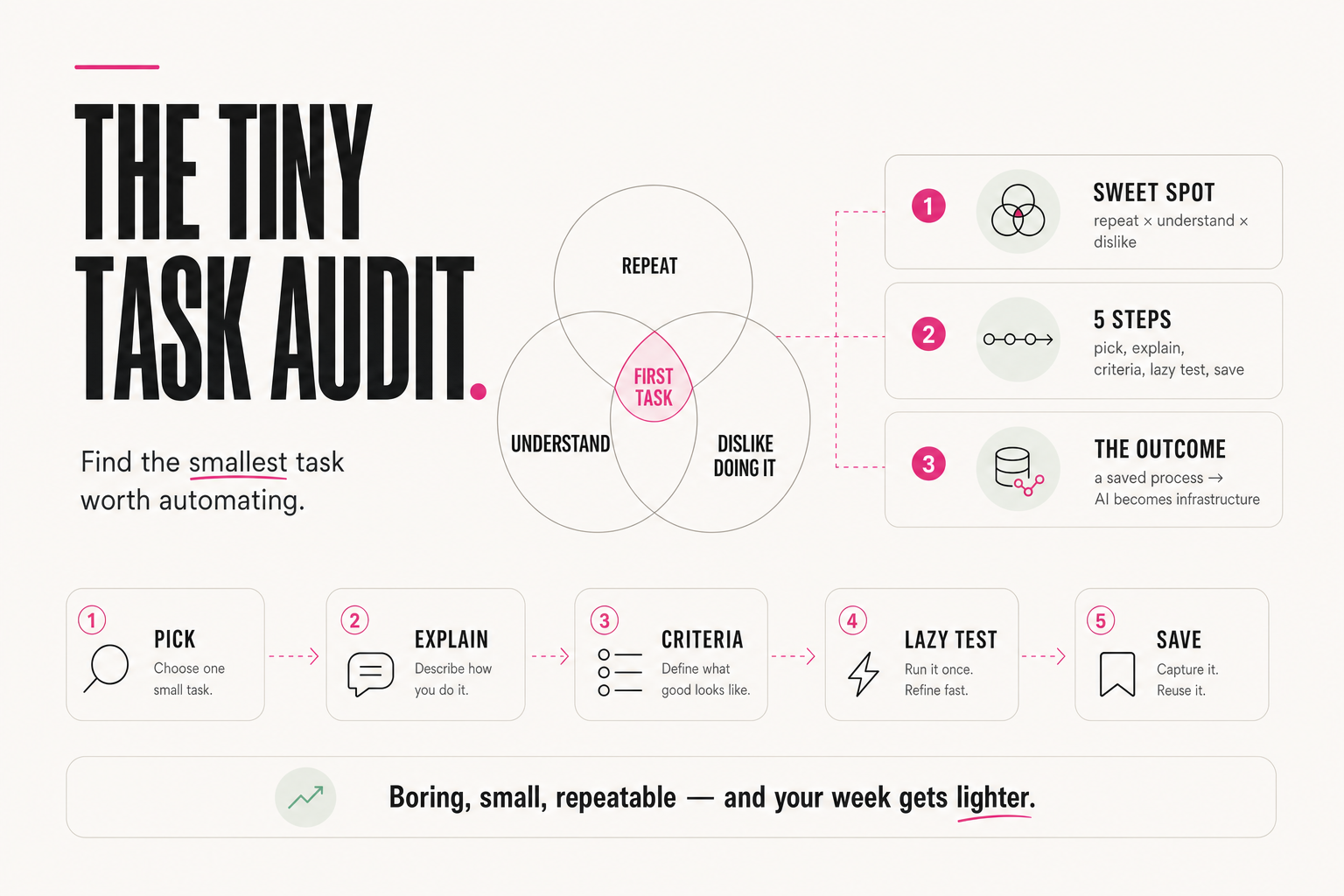
Here's how our [interview/onboarding/assessment] runs today,
step by step: [describe freely].
Pull out: 1) which steps repeat identically every time,
2) which criteria you keep in your head but never wrote down,
3) what could become a template today.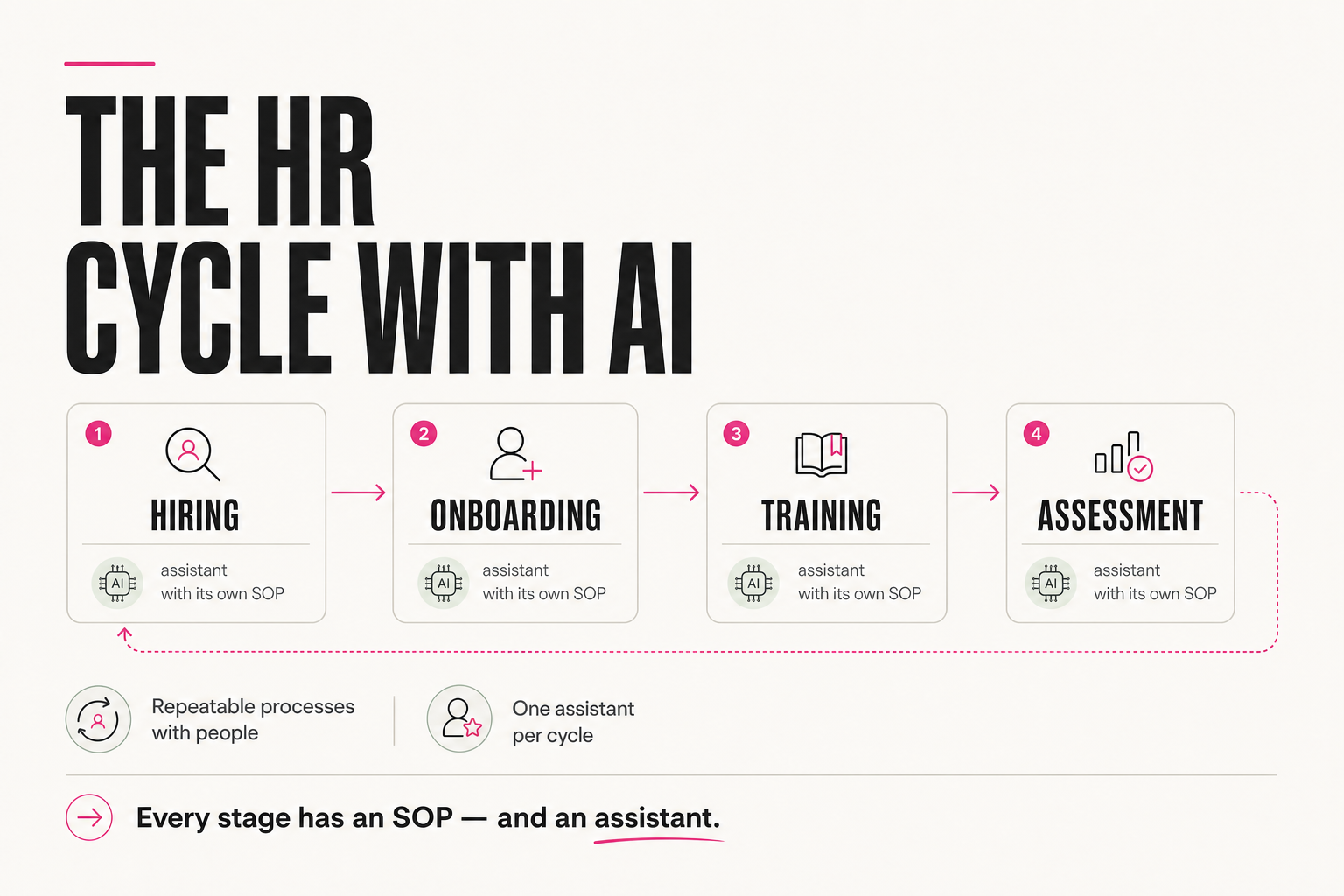
02 — The session cycle
How does session and assessment analysis get automated?
The most structured pattern from the cases is a three-step cycle around any session (interview, review, training):
- Prep — AI assembles a brief on the candidate/employee: inputs, history, questions matched to the meeting's goal;
- Assessment — after the session, notes or a transcript turn into a structured evaluation against your criteria;
- Strengths and growth areas — the output is a concrete development plan, not a vague "good job, keep trying."
This used to take an hour per person — so it was done shallowly or not at all. Now the depth of the review no longer depends on an HR person's free evening.
Candidate/employee: [resume or history, anonymized].
Meeting goal: [role assessment / performance review / growth plan].
Build a brief: 3-5 questions matched to the goal, what to watch
for in the history, where red flags might be, what to confirm live.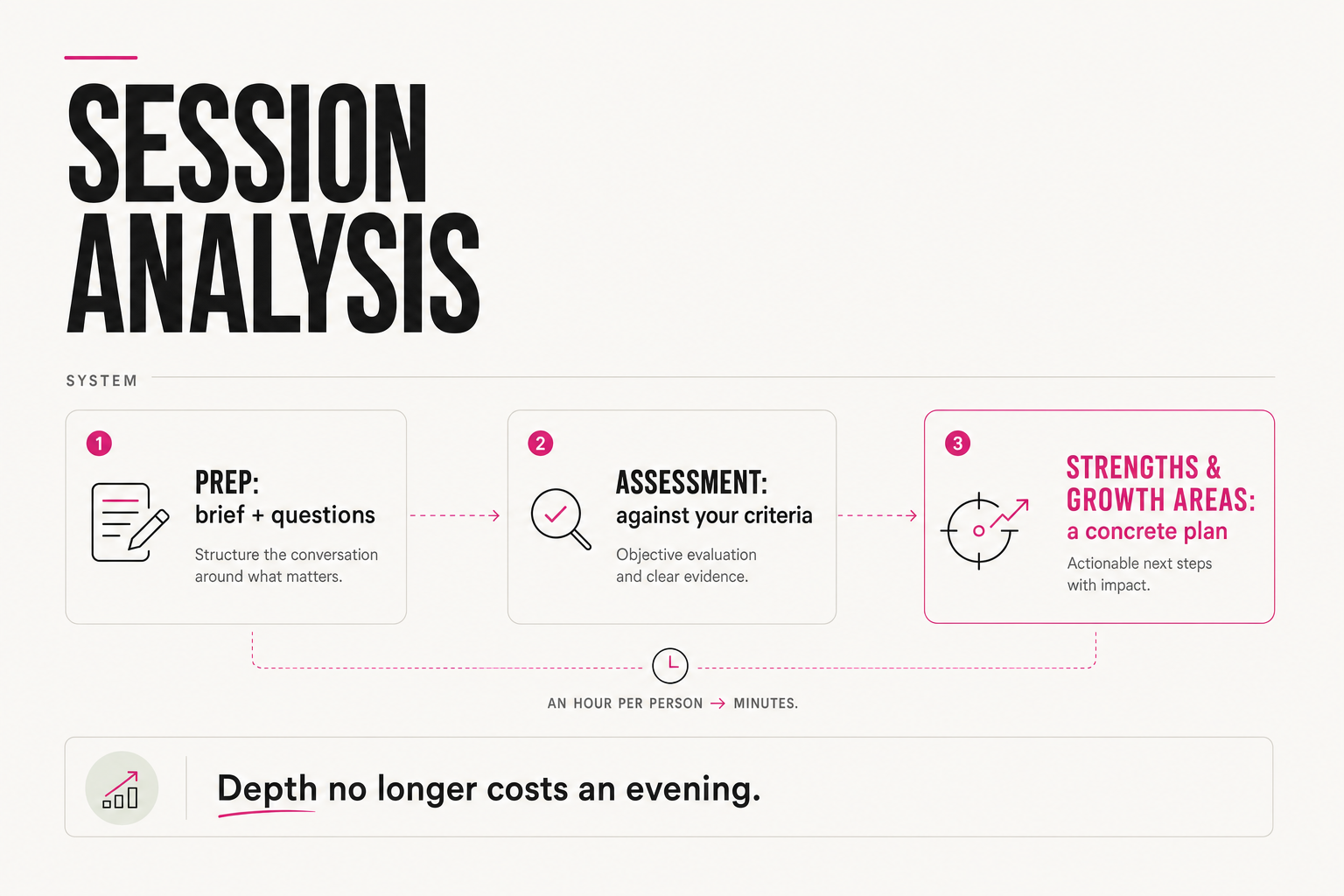
03 — Custom GPTs
What assistants does HR build for itself?
Per the cases, HR builds custom GPTs for specific processes: resume screening against role criteria, candidate email drafts for every stage, an onboarding navigator for newcomers, career-guidance tools.
An important observation from one participant: "AI raises the quality of your toolkit if you build for more than marketing" — meaning working tools for internal processes, not showcase bots. The same principle as everywhere: one assistant = one process with its own SOP, not a "universal HR bot."
A "company HR assistant" for everything at once — answers in generic phrases, nobody at the company actually uses it.
A separate GPT for "screen resumes for role X" with the role's criteria spelled out — narrowed the task, and it gets used every week.
04 — The principle
"AI is a first-grader": why is this the best mental model?
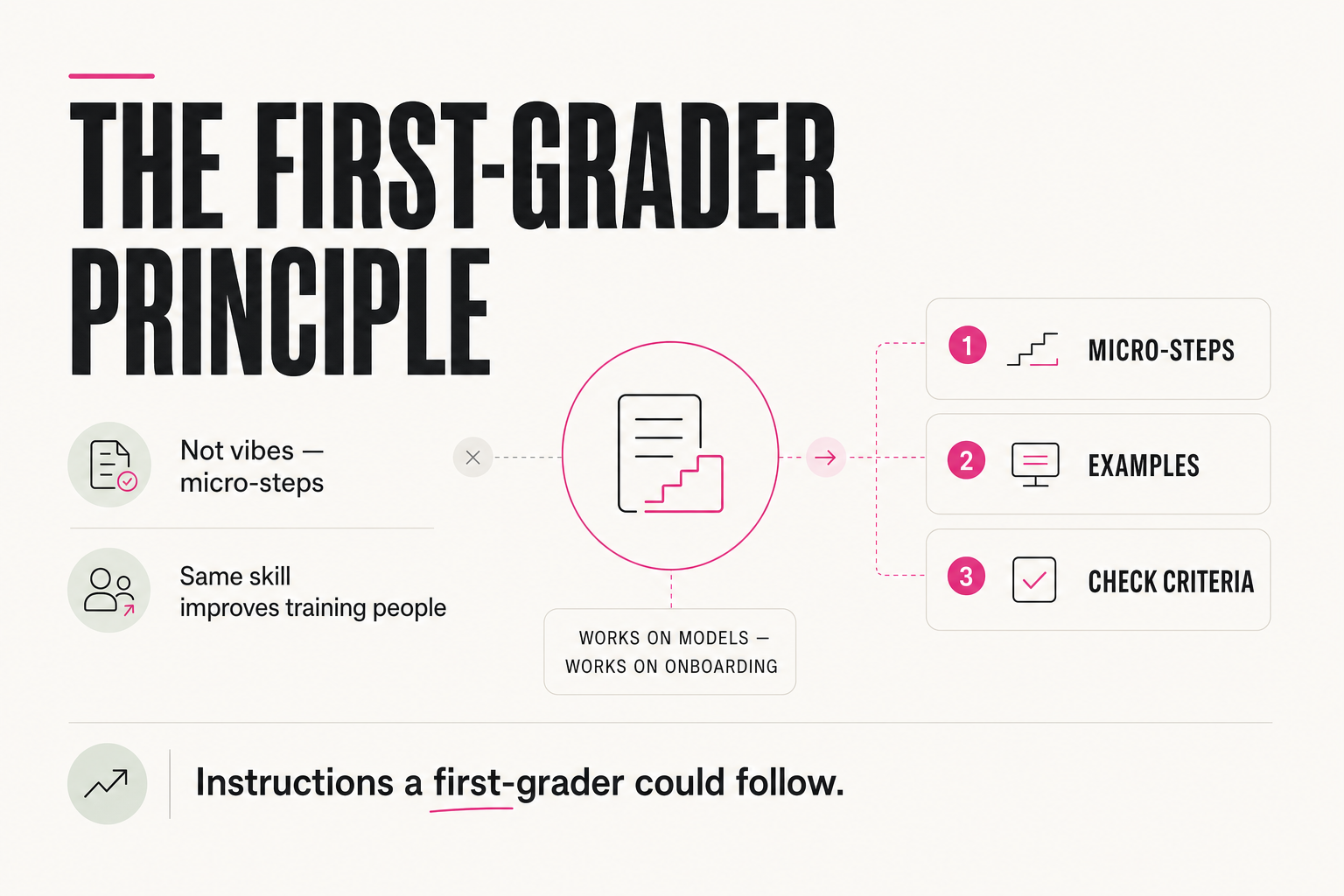
AI is a first-grader that needs clear instructions and micro-steps.— an HR expert from the focus group
This formula from the case is the best mental model for working with AI, period. You don't tell a first-grader "do it well" — you give small steps, examples, and you check the result. That's exactly how to set tasks for a model: micro-steps, criteria, samples.
Then comes the beautiful reversal: the HR people in the base noticed the same skill improves training human employees. Break a process into micro-steps, give examples, set criteria — that's what good onboarding is. Prompting turned out to be a gym for managerial clarity.
"Make an onboarding plan for a new hire" — the output is a generic plan that ignores the specifics of the role and team.
"Here's the role, here are 3 common newbie mistakes, here's what should be done by the end of week 1/2/4 — build a plan around those milestones" — a concrete, working plan.
05 — The limits
What does HR not hand to AI?
HR's boundaries are about people and data:
- Decisions about people — hiring, firing, promotion are made by a human; AI prepares the material, not the verdict;
- Personal data — resumes and assessments carry sensitive information: anonymization or enterprise environments are mandatory;
- Bias — a model can inherit skews from your own examples; screening criteria should be checked for discriminatory patterns.
Same scheme as with lawyers: AI is the draft and the structure; the human is the decision and the responsibility.
Here are my screening criteria for role X: [paste the list].
Check: 1) are there proxies for gender, age, nationality here
(e.g. "graduate of a specific university" or "no gaps in
employment")? 2) which criteria should become direct,
measurable skills instead?
06 — Where to start
Where should HR start this week?
1. Take one cycle: say, interview debriefs
2. Formalize the assessment criteria (what you look at, what "good" is)
3. Prompt: "here are my interview notes [anonymized], here are the
   criteria — assemble an assessment: strengths, growth areas,
   recommendation"
4. Test on 3–5 past interviews, refine the criteria
5. Rules: decisions about people are yours; data is anonymizedHR processes parametrize like no others: prep → assessment → growth areas, custom GPTs per cycle. Set tasks for AI like for a first-grader — micro-steps with examples — and you'll notice you've started training people better too.
FAQ
What should HR automate first?
The session-analysis cycle: a prep brief → a structured assessment against your criteria → strengths and growth areas. Per the cases it's the fastest win: review depth stops depending on a free hour, and the development plan becomes concrete instead of "good job, keep trying."
Can AI be trusted with hiring decisions?
No — decisions about people (hiring, firing, promotion) are made by a human. AI prepares the material: criteria-based screening, structured assessments, email drafts. And check your criteria for bias: a model can inherit skews from your own examples.
What about candidates' personal data?
Anonymize it or use enterprise environments with data controls. Resumes and assessments are sensitive; they shouldn't reach public models. The working scheme: templates and criteria live in the assistant, concrete data goes in minimally and without identifiers.
What does "set tasks for AI like for a first-grader" mean?
The focus-group HR expert's formula: a model needs clear instructions and micro-steps — like a first-grader. Not "do it well," but small steps, examples and checking criteria. The bonus: the same skill improves onboarding and training of real employees — it's the same managerial clarity.