AI for coaches and mentors: from task chaos to a system
108 coach cases in the focus-group base. The main pain isn't "I can't use AI" — it's "I don't know what to delegate." Here's what works.

01 — The pain
Why does a coach live in chaos — even with strong expertise?
Coaching is an orchestra profession: sessions, programs, content, sales, client agreements. Across the base, the pain is phrased not as "I can't use AI" but as "too many tasks and materials, I don't know what to delegate" and "chaos in my processes."
The expertise is strong — but it lives in the head and in spoken hours, not in a system. So for coaches AI works first of all not as a "post writer" but as a way to lay their own practice out on the table — and see what in it is a product, what is content, and what is routine to delegate.
Here's how I work with clients (describe freely, 5-10 sentences).
Sort it into:
1) What here is a product I could sell separately?
2) What is content I could turn into posts/lessons?
3) What is routine I could delegate without losing quality?
Give me a list for each category, using examples from my own text.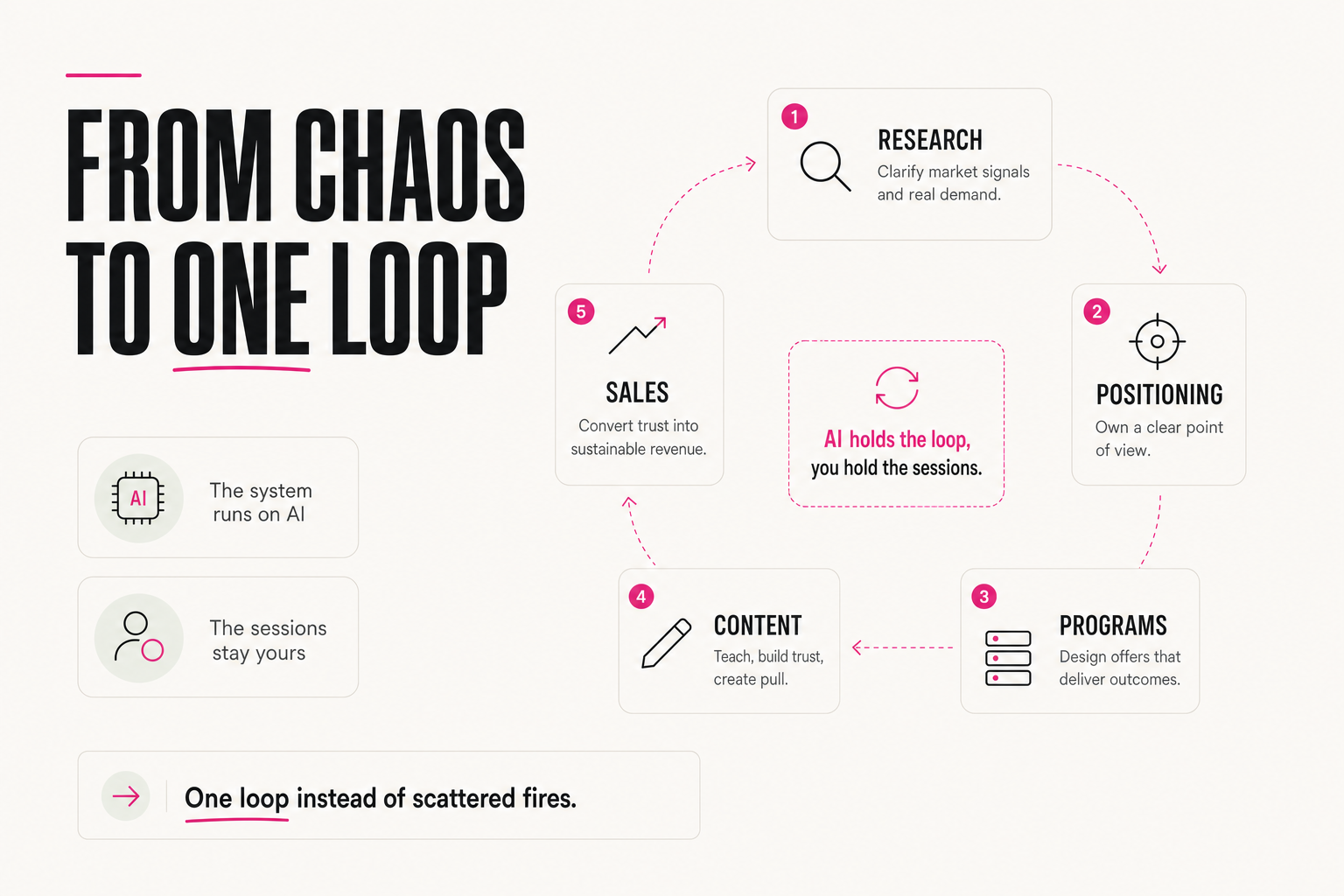
02 — Research
How do coaches use AI to understand clients?
The most underrated pattern in the cases is audience research. One coach had AI compile a 40-page research report on her clients' needs — the kind of thing people used to commission from an agency.
The second move is segmentation on the awareness ladder, ending in an emotional portrait: what level the client is at, what words they use for their pain, what drives them. That portrait then feeds everything: content hits their phrasing, programs hit real requests, sales hit real objections. Coaching starts with understanding a person — AI makes that understanding systematic.
My audience: [describe the niche and 3-5 real clients, no names].
Build a research report: main pains in clients' own words, what
they already tried and why it didn't work, what awareness level
they're at now, what they fear about approaching a coach.
Split by segment if the audience isn't uniform.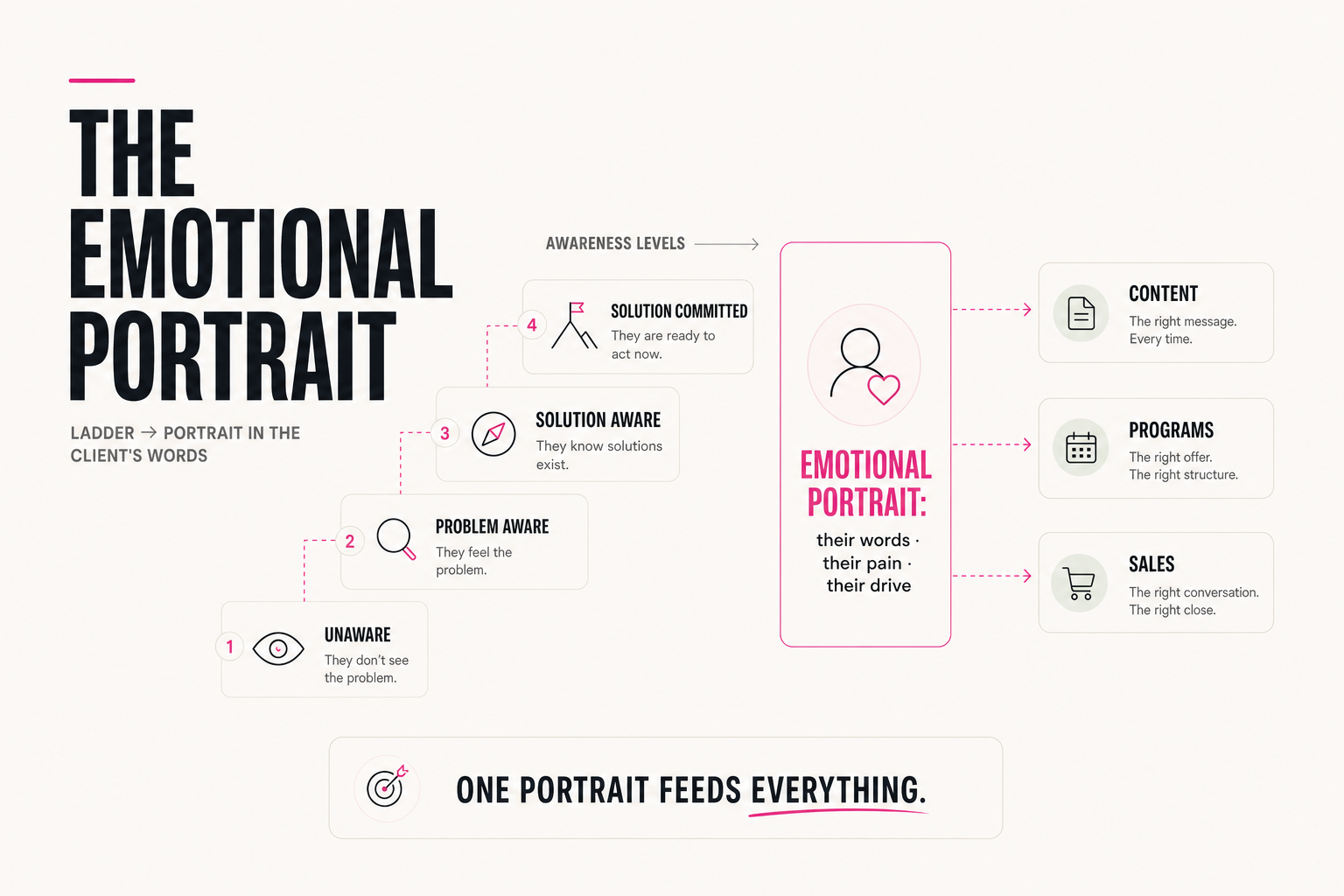
03 — Voice to program
How does a voice note become a program?
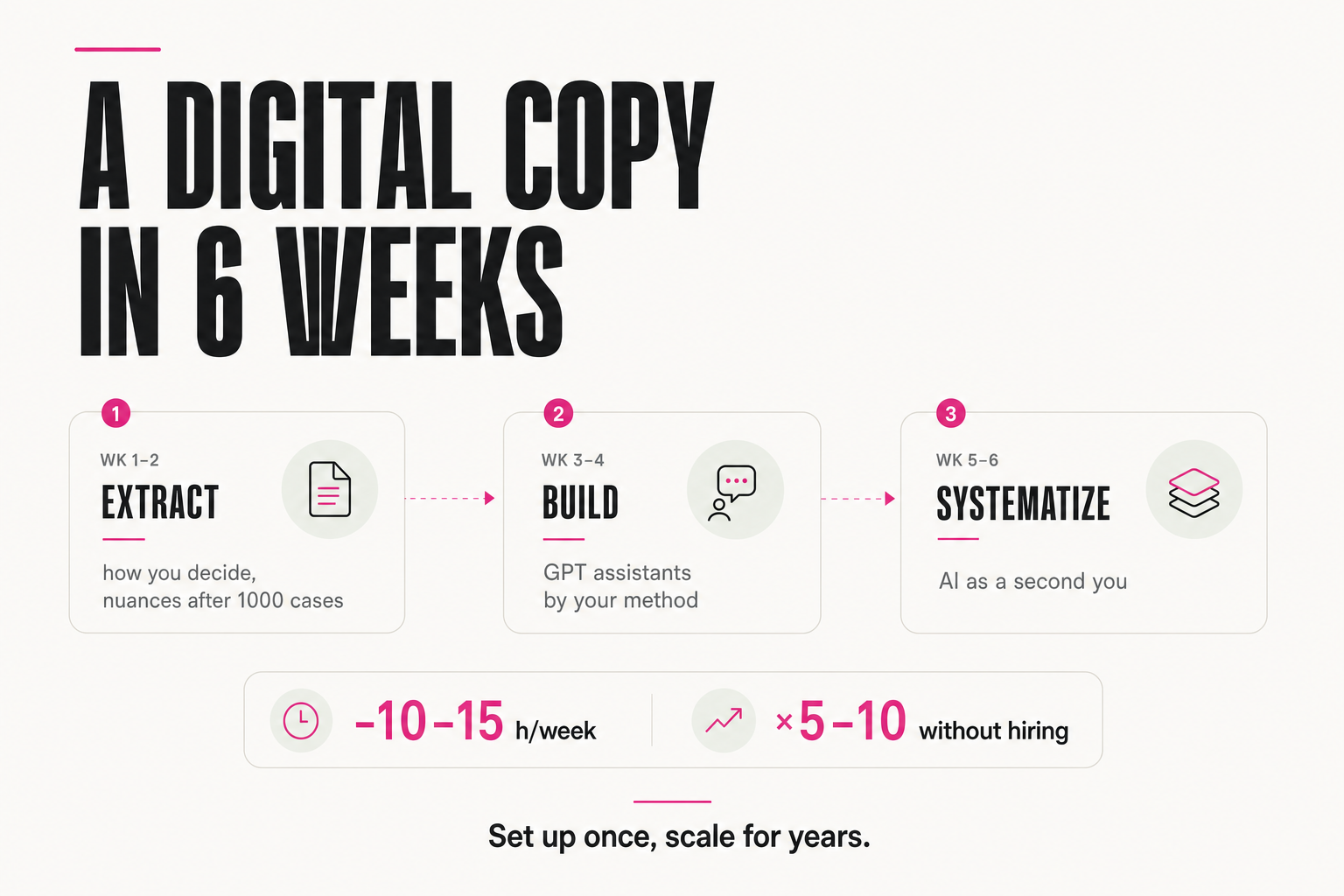
The pattern that repeats most often among coaches: speak the method out loud — and get a structure. One participant recorded a voice note about how she guides clients — and minutes later had a formatted training syllabus: modules, order, assignments.
Same logic as psychologists with lead magnets: out loud, an expert explains more vividly than in writing. AI doesn't invent the program — it structures what the coach already does on autopilot. Often this is the first time a person sees their own method from the outside — and realizes they have something to sell.
Here's the transcript of my voice note about how I guide a client
from request to result: [paste text].
Build a program structure from it: split into modules, order them
from simple to complex, add an assignment to each module.
Keep my own phrasing and metaphors — don't smooth them over.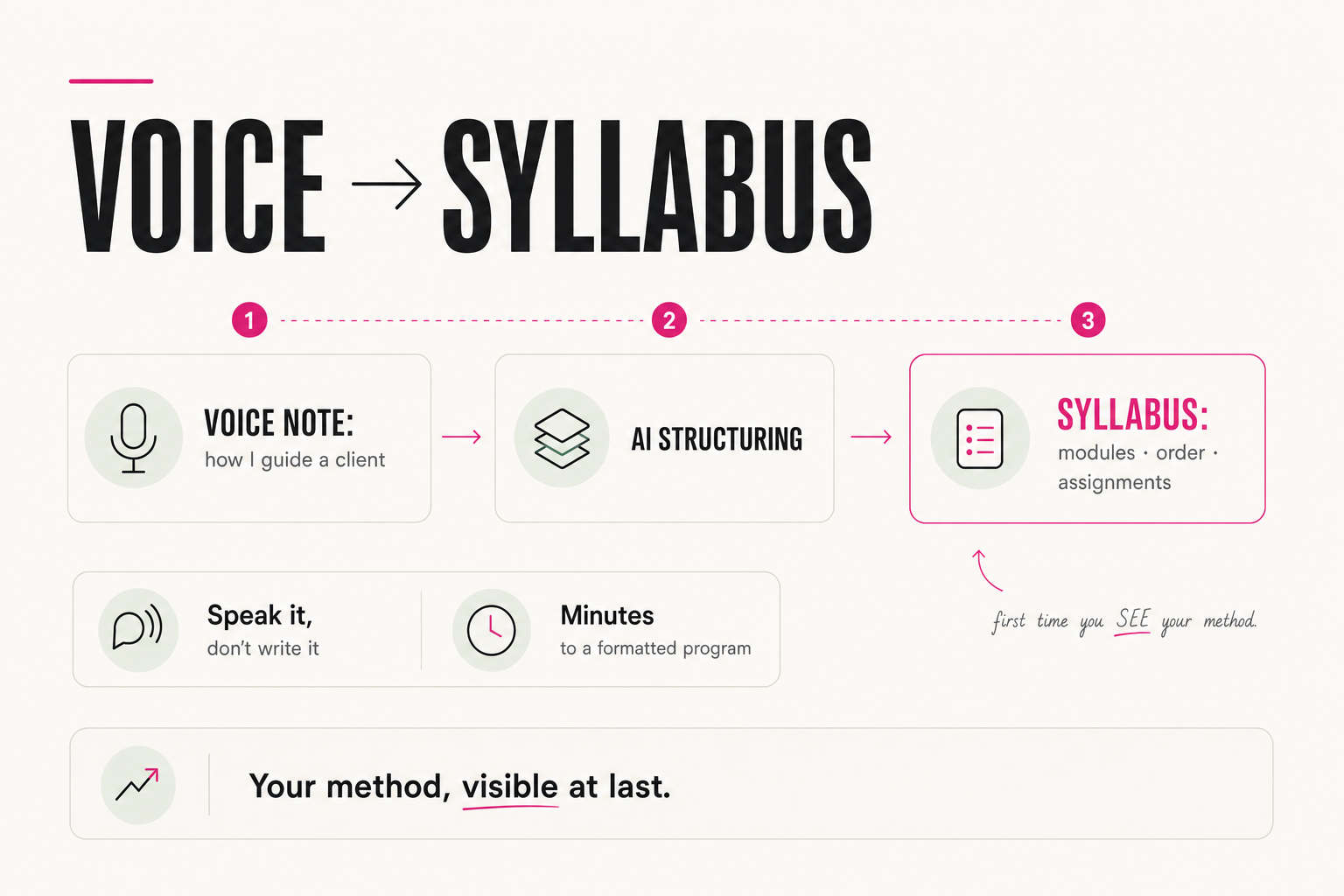
04 — Operations
What else gets delegated: contracts, matrix, sales
Less obvious but frequent uses from the cases:
- Contract analysis — AI finds hidden contradictions in client agreements before they blow up;
- Product matrix — analyzing the lineup: what duplicates, where the gap is, where the margin sits; one participant confirmed her strategy this way and found optimization ideas;
- A deep dialog about one's own trajectory — several coaches noted that a structured AI conversation about their career story produced a breakthrough — the very tool they give clients worked on themselves.
Here's my standard client contract text: [paste it].
Check: 1) Where can wording be read two ways?
2) What's not covered (rescheduling, refunds, force majeure)?
3) What could become a conflict in 2-3 months?
Give me a risk list and suggest wording to fix each one.
05 — The meta-skill
Why does prompting train the coaching mind?
The most interesting observation came from one participant: "writing instructions for AI is like writing code" — project-management principles map perfectly onto prompting. For AI to deliver, you need a clear goal, context, criteria and steps.
But that's also the core of coaching: clear questions, decomposition, criteria for the result. Coaches in the base noted that after weeks with AI their sessions got more structured: the machine mercilessly exposes fuzzy phrasing. AI turned out to be a clarity gym — a side effect worth more than the automation itself.
"Help me with a program for clients" — AI returns a generic template that fits no one in particular.
"Build a program for [segment], the goal is [specific result] in [timeframe], here are 3 examples of my own phrasing" — AI returns something you can actually sell.
06 — Where to start
Where should a coach start this week?
1. Voice-record how you take a client from request to result
2. Transcript → AI: "assemble a program structure: modules,
   order, assignments; keep my phrasing"
3. In a separate chat: "build my client's emotional portrait
   by awareness levels — here are 5 real requests: […]"
4. The portrait feeds content and sales; the structure is a product
5. Worked? Save both prompts, repeat for every cohortFor a coach, AI is structure first: client research, a method pulled out of voice notes, order in contracts and the product matrix. The sessions stay yours; the system around them stops running on memory and midnight heroics.
FAQ
What should a coach delegate to AI first?
Structuring your own method: voice-record how you guide clients and ask for a syllabus — per the cases this takes minutes and shows your method from the outside for the first time. In parallel, an emotional audience portrait by awareness levels: it feeds content, programs and sales.
Can AI replace a coaching session?
No — live contact, questions in the moment and responsibility stay with the coach. Per the cases AI takes the system around sessions: research, programs, content, contracts. Notably, coaches use a structured AI dialog about their own trajectory as a tool for themselves — but as an addition, not a replacement.
How does AI help understand a coach's audience?
Two moves from the cases: a deep research report on needs (up to 40 pages) and segmentation on the awareness ladder ending in an emotional portrait — what level the client is at and what words they use for their pain. That portrait then feeds content, programs and objection handling.
Does prompting really improve the sessions themselves?
Per participants' observations — yes: setting tasks for AI demands a clear goal, context and criteria — the same skills as a strong session. The machine mercilessly exposes fuzzy phrasing. Several coaches noted their sessions became visibly more structured after weeks with AI.