Voice memo → finished post in 2 minutes: the prompt that turns speech into real writing
You explain things better out loud than in writing. Here's the mechanic that turns a voice message into a post people actually read — with a step-by-step guide and a prompt you can copy.

01 — The pain
Why don't voice messages turn into posts?
You know the situation: you recorded a great voice message — feedback for a student, an answer to a client, a thought after a call. You listen back and realize: this is ready-made content. Then you try to turn it into a post and get "point one, point two, point three."
That's exactly what one member of my focus group came with. She's a mentor who often gives students feedback in voice messages — always solid material for her channel. But every attempt to turn a memo into a post ended in an outline. She wanted a coherent text that reads like a story. She kept getting meeting minutes.
We solved it on a group call in a couple of minutes. And the fix wasn't "try harder at writing" — it was changing how the task is given to the AI.
02 — The mechanic
Why doesn't "transcribe and polish" work?
When you ask AI to "make a post from this transcript," it does literally what you asked: it compresses speech down to the substance. And substance without intonation is a list of bullet points. The liveliness you love about your voice notes is the first thing thrown away.
"Here's a transcript of my voice memo. Turn it into a post." → Output: a tidy summary. Point one, point two. Reads like the minutes of a meeting.
"First understand what's in the audio. Build the structure. Think through the delivery — examples, stories. Write a headline with intrigue. Keep the author's manner of speaking." → Output: a coherent text that pulls you in.
The difference: a good prompt breaks the editor's job into stages — understand → structure → deliver → hook. That's how a human editor turns an interview into an article. AI can replicate it — if you ask for it explicitly.
03 — The guide
Voice memo to post in 4 steps
The whole mechanic takes about two minutes. Walk through it below — the guide is interactive, move one step at a time.
Don't prepare anything special. The best material is the voice messages you already record: feedback to a student, an answer to a client, a thought after a meeting. Speak the way you speak — with all the tangents. That's your voice, and the prompt will ask to keep it.
Forward the memo to any transcription bot or use your messenger's built-in transcription. Quality isn't critical: the model handles typos and filler words just fine. Don't edit the text by hand — you'll lose time and liveliness.
Open ChatGPT or Claude, paste the prompt from the next section, and put the transcript below it. The prompt makes the model understand the content first, then build structure and delivery — and only then write.
A quick pre-publish check: 1) the text reads like a story, not a list; 2) the headline makes you want to know "wait, what happened?"; 3) it sounds like you — the same words as in the audio. If something's off, tell the model exactly what — the second pass almost always lands.
04 — The prompt
What prompt turns speech into a coherent text?
Here's the prompt from that group call — grab it with the Copy button:
Hi! I need you to turn the following audio transcript into a good, substantial, flowing, coherent post for my channel — no bullet points, no breaks, a text that reads like a story, pulls you in, and keeps the author's manner of speaking from the audio itself.

To do that, first understand what's actually in this recording, and work out the structure: how to deliver this idea logically, how best to lay it out.

Second: think through how to get the idea across — which examples and stories to use, how to present it so the reader gets drawn in.

Also craft a gripping headline that creates intrigue and a sense of something left unsaid — so that anyone who sees it needs to find out what happened next.
Notice: the prompt is written conversationally, almost like a voice memo itself. That's not an accident — I often dictate my prompts out loud. What matters isn't polished wording but the three jobs built into it:
- Structure. "First understand what's in the audio and work out the structure" — the model doesn't write from word one; it lays the idea out first.
- Delivery. "Think through which examples and stories carry it" — instead of compressing into bullets, the model looks for what keeps the reader in.
- The hook. "A headline with intrigue and something unsaid" — the reason the post gets opened at all.
05 — Make it yours
How do you adapt the prompt to your platform and format?
The base is universal, but a channel post isn't the only output. The same voice memo can become a short-video script, a newsletter issue, a LinkedIn post. Build your own version — fill in the fields and the text assembles itself:
One detail that decides a lot: don't ask it to "rewrite this nicely." Ask it to keep the manner of speaking from the audio. The moment the model starts "improving" your language, the text stops being yours — and readers feel that faster than you'd think.
06 — The system
What changes when this becomes a habit?
The interesting part starts a couple of weeks in. Voice messages stop being "messages" and become raw material: every breakdown, every substantial reply to a client is a post draft that takes two minutes to finish.
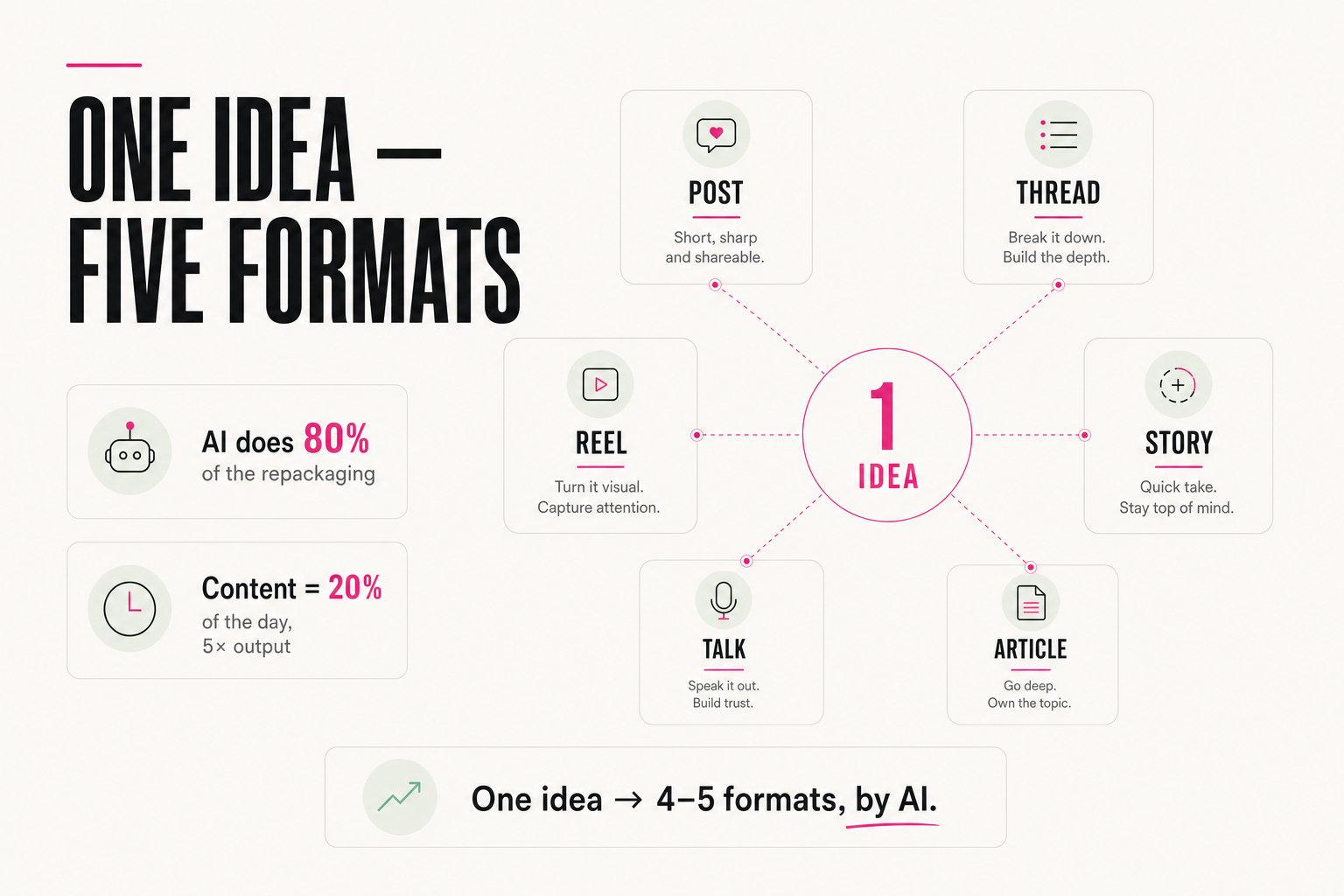
My entire content system runs on this principle: I don't sit down to "write a post" — I talk, into notes, into chats, on calls — and one spoken thought becomes 4–5 pieces of content across platforms. I broke the full system down in the article on how one idea becomes five formats.
Mon–Fri: record voice memos as usual (replies, feedback, thoughts)
Fri, 20 min: forward the 3–5 best ones to a transcription bot
→ run each transcript through the prompt from section 04
→ you get 3–5 posts for next week
Result: a content plan built from what you said out loud anywayYour voice messages are finished content minus an editor. The prompt in this article is that editor: structure → delivery → headline, keeping your voice intact. Try it on your very next memo — recording to post genuinely takes two minutes.
FAQ
I don't have "content-worthy" voice memos — where do I start?
With what you already have: replies to clients, feedback to students, thoughts after calls. If there's truly nothing, dictate a 2–3 minute thought into your phone as if explaining it to a friend. Live speech is almost always richer than the text you'd write from scratch.
What should I use for transcription?
Whatever's handy: transcription bots, your messenger's built-in transcription, your phone's dictation. Quality isn't critical — the model works fine with typos and filler words, and your speaking style actually comes through clearer with them.
The post doesn't sound like me. What now?
Check that the prompt still contains the line about keeping the author's manner of speaking — without it, the model starts "improving" your language. If it's still off, add 2–3 of your old posts as voice examples: showing your style always beats describing it.
Does this work with videos and calls, not just voice memos?
Yes — same mechanic: any recording of speech → transcript → prompt. An hour-long call yields several posts, not one: ask the model to first extract 3–5 standalone ideas, then turn the one you pick into a post.