AI for teachers and methodologists: turn a lecture archive into living materials
Education is the second most active niche in the base: 285 cases. Reverse prompting, recording archives and a team of assistants — what actually works.

01 — The niche
Why is education the #2 niche in AI adoption?
285 cases in the base — only marketing has more. The logic is on the surface: teachers and methodologists produce huge volumes of structured text — programs, lessons, assignments, feedback. All of it is repeatable work with clear criteria for "good" — the perfect zone for AI.
And the pain is always the same: "systematizing my processes." An educator's material accumulates for years — recordings, PDFs, decks — and lies there as a dead archive. AI is the first thing that turns that archive into a working asset.
Answer: 1) How many recordings/PDFs/decks have sat unrepurposed
for over six months? 2) If you needed a new course tomorrow, how
much of that material would you actually reuse vs. write from scratch?
If (1) is over 5 and (2) is under half, you have a dead archive —
and that's the fastest entry point for AI.
02 — Reverse prompting
What is reverse prompting — and why is it a methodologist's best trick?
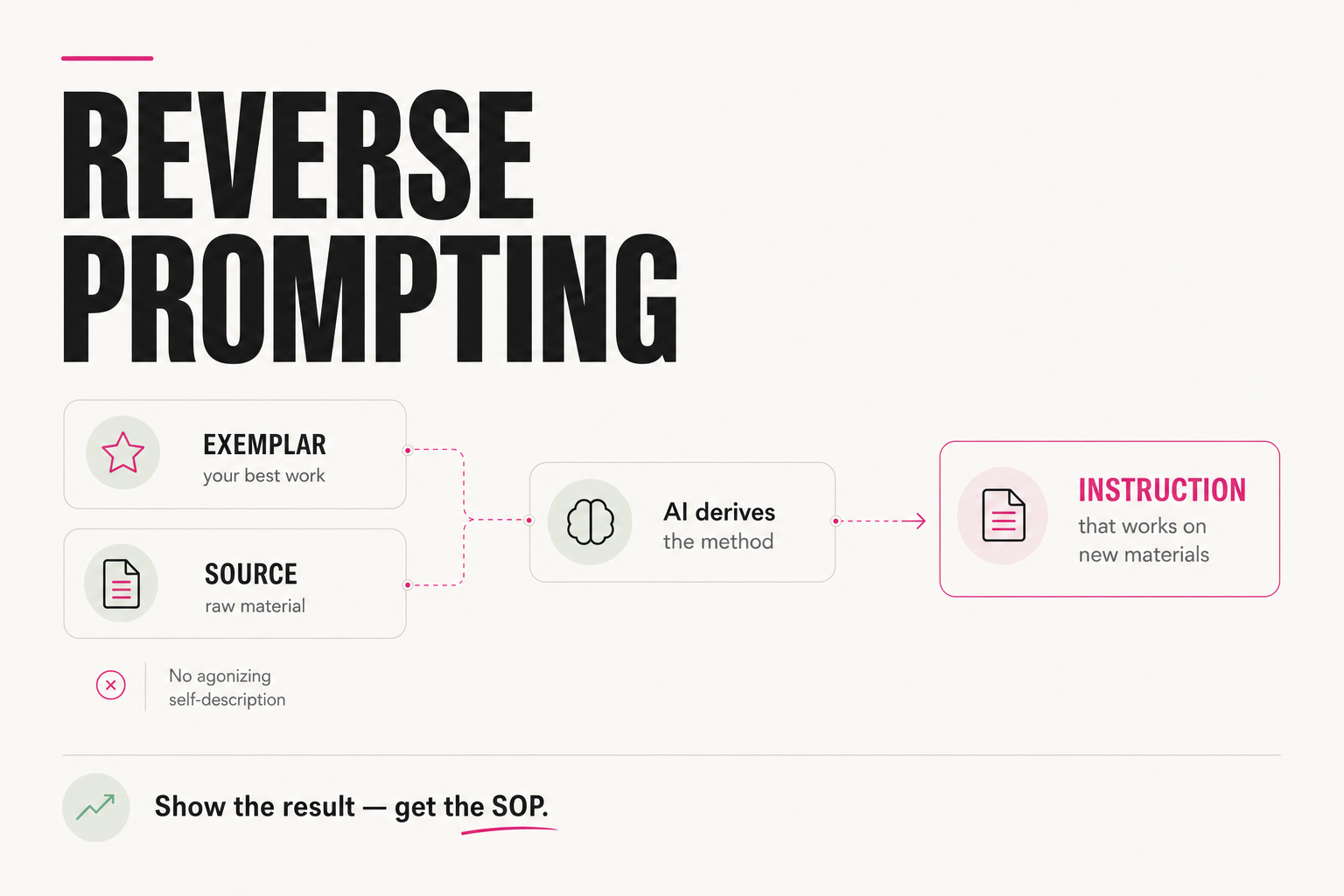
The most elegant move in the cases. People usually struggle with "how do I write an instruction so AI does it right?" The methodologists in the base go the other way: they give AI an exemplar result + the source material — and ask it to derive the instruction that turns the second into the first.
"Here is the source material: [raw]. Here is the result I made
from it by hand and consider the standard: [exemplar].
Derive a step-by-step instruction: how to get this kind of result
from this kind of source. The instruction must work on new materials."
Show once how you do it — and you get an SOP you can hand to an assistant, a team, or a junior methodologist. It's expertise digitization without the agonizing "sit down and describe my method."
03 — The archive
How does an archive of recordings become materials?
Every educator has deposits: webinar recordings, lectures, PDFs, old decks. Per the cases, this is the fastest source of value: participants uploaded past recordings and documents — and AI assembled teaching materials from them: summaries, assignments, tests, handouts.
One university lecturer went further: her AI assistant didn't just propose formats — it built a website for the teaching project on its own. Material that had waited "for later" for years turned into a product within weeks. The rule is simple: don't create from scratch what's already been said out loud — repackage it.
Here's the transcript of a [lecture/webinar] recording: [paste it].
Assemble: 1) a summary of the key points,
2) 5 assignments at different difficulty levels on this topic,
3) a short comprehension test (5 questions).
Keep my own terminology and examples — don't swap in generic ones.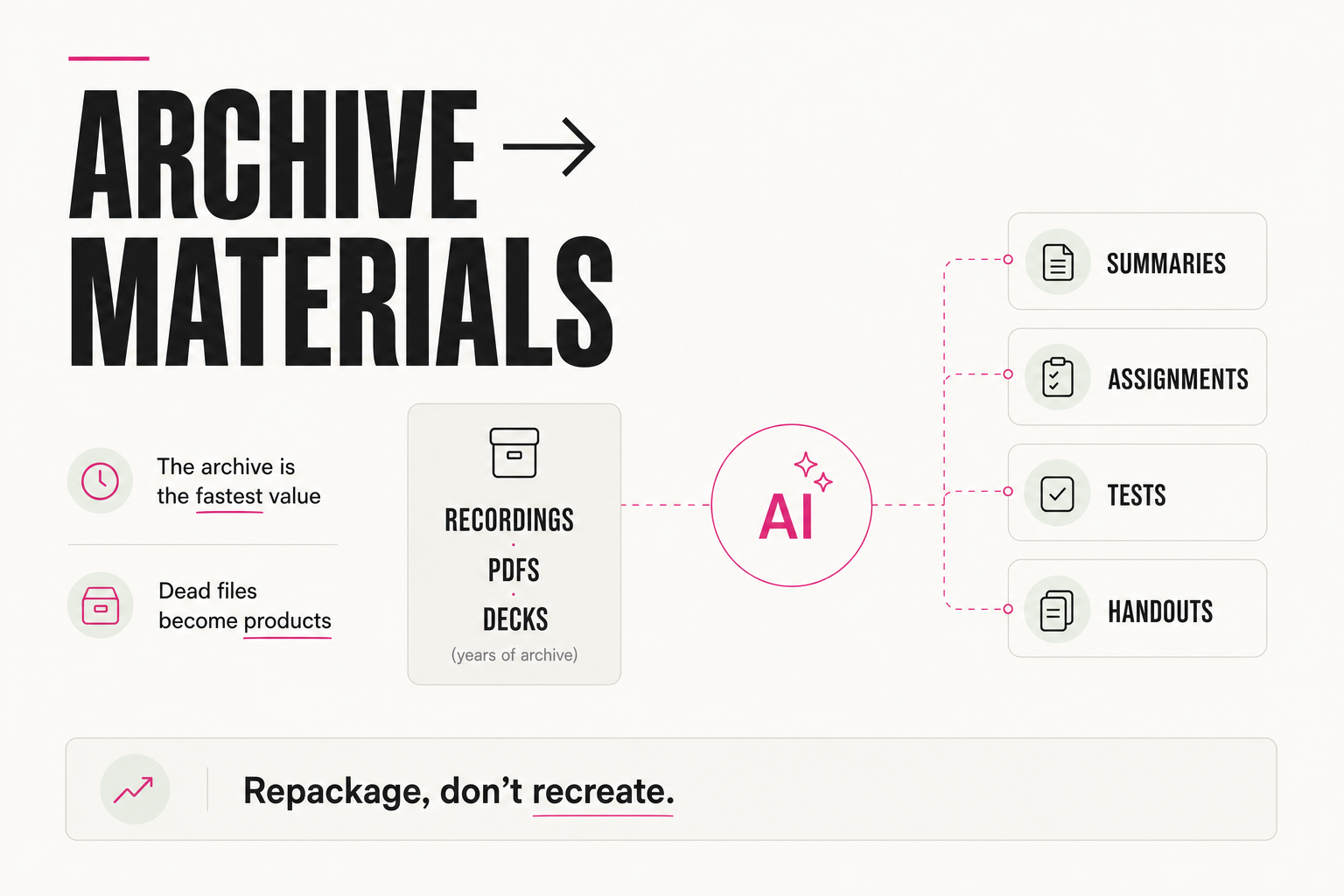
04 — Assistant team
Why does one "universal" assistant lose to a team?
The pattern of the mature cases: not one do-it-all assistant, but a team of specialized ones — storyselling separately, design-prompt generation separately, assignment checking separately. Each carries its own slice of the method with its own criteria.
It's the same logic as agent skills: instructions don't compete for one context. For a methodologist this is especially natural — decomposing a process into roles and SOPs is the profession. Participants noticed something unexpected: their automation ideas turned out to be products — SOPs built for themselves get bought by colleagues and schools.
Role: only checking assignments for topic X.
Grading criteria: [fill in 3-4 concrete criteria from your method].
Response format: a score + exactly what to fix, no generic
phrases like "not bad, could be better."
Don't: don't offer to rewrite the student's whole answer.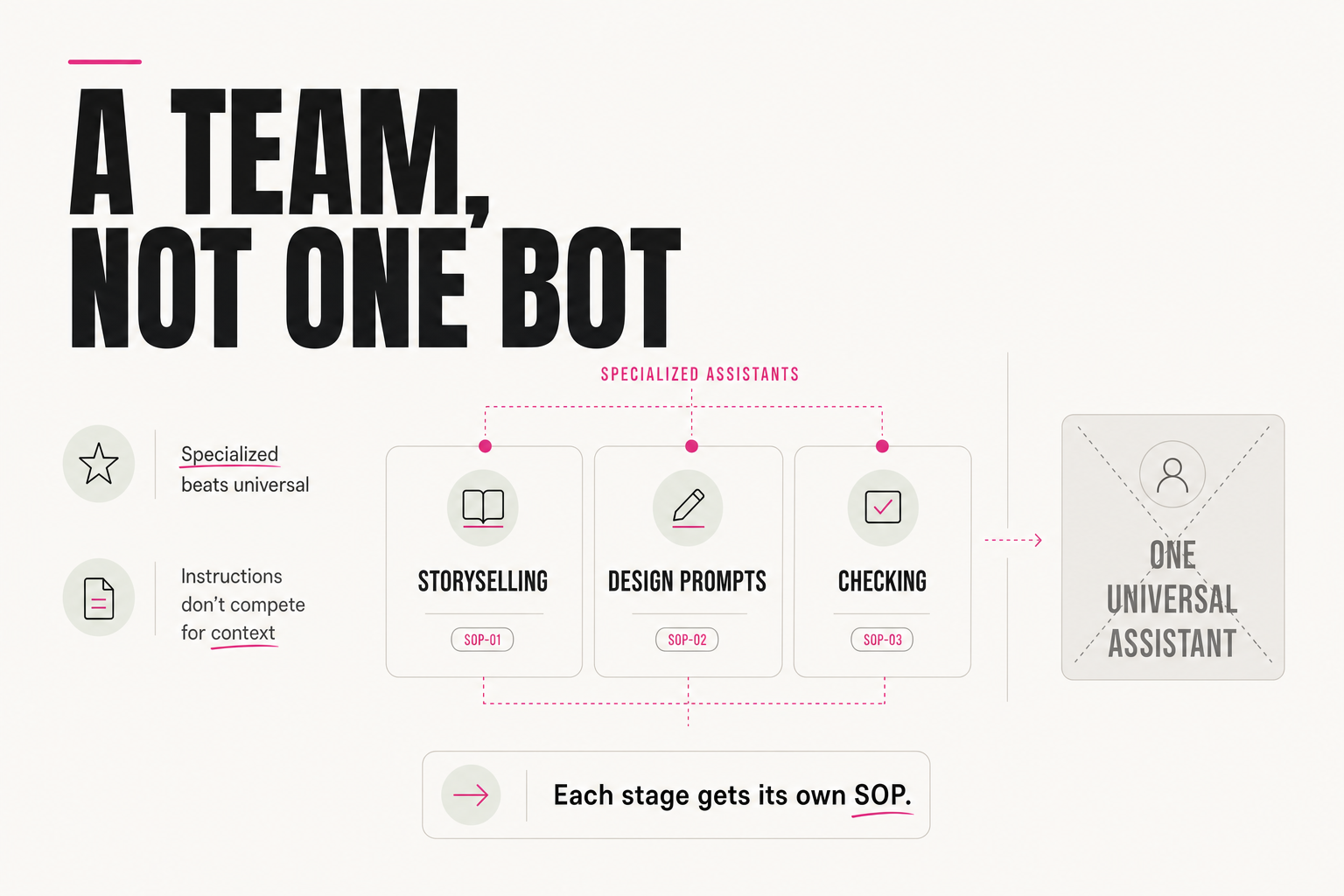
05 — Quality
How does AI test student and material readiness?
Another pattern from the cases — AI as an examiner. Readiness stress-tests: the model grills a student (or the material itself) with tricky questions before reality does. Material that fails AI's questions gets fixed before launch, not after a cohort flops.
One methodologist's exact phrasing: AI's value is "stability of thinking, memory, and predictability over distance." Methodology is the memory of a business; AI is the first thing that makes that memory cheap to maintain.
Here's my teaching material: [paste it].
Pretend you're the most nitpicky student. Ask 10 tricky
questions the material doesn't directly answer.
For each question, suggest what to add to the material
so it can hold up against it.
06 — Where to start
Where should an educator start this week?
1. Take one lecture/webinar recording from the archive
2. Transcript → AI: "assemble a summary + 5 assignments + a test;
   format — the way I do it: [attach one exemplar of yours]"
3. On the exemplar → reverse prompting: derive the instruction
4. The instruction → into an assistant: now it runs without you
5. Next piece of the archive → same conveyorFor an educator AI isn't "generate a lesson" — it's bringing your archive to life and digitizing your method: reverse prompting instead of agonizing self-description, an assistant team instead of midnight formatting, stress-tests before launch. Methodology stops being boring — it becomes an asset.
FAQ
What is reverse prompting?
A move from the focus-group methodologists: instead of writing an AI instruction from scratch, you give it an exemplar result and the source material — and ask it to derive the instruction that turns one into the other. You get an SOP you can hand to an assistant or a team — method digitization without agonizing self-description.
What do I do with an archive of old recordings and PDFs?
Repackage rather than create from scratch: per the cases, participants uploaded past recordings and documents, and AI assembled summaries, assignments, tests and handouts from them. One lecturer's assistant went as far as building a website for the teaching project itself. The archive is the fastest source of value.
One powerful assistant or several specialized ones?
Per the mature cases — a team of specialized ones: storyselling, design prompts, assignment checking — each with its own slice of the method and its own criteria. Instructions don't compete for one context, and each stage runs on its own SOP. For a methodologist it's natural: decomposing a process into roles is the profession.
Can AI replace a teacher?
Live explanation, motivation and adapting to a specific student — no. Per the cases AI takes over material production, checking standard assignments and readiness stress-tests. The teacher stays in the classroom; what disappears is the midnight formatting of summaries and assignments.