AI for psychologists: what actually works — from focus-group cases
Psychologists are one of the most active niches in AI adoption. What they delegate, where the ethical line runs, and how a voice recording becomes a lead magnet in 20 minutes.

01 — Why psychologists
Why do psychologists adopt AI more actively than IT people?
In my focus-group base, psychologists and adjacent helping practitioners outnumber technical specialists. The reason isn't love of technology — it's the shape of the profession: expert time gets eaten by everything around the sessions — content, teaching materials, messages, curators, product packaging.
There's a second motive: psychologists' clients already go to ChatGPT. People open a chat, type "you're an experienced psychologist" — and get the illusion of a consultation. An expert who can't explain their difference from a free bot loses. An expert who puts AI to work for them wins twice: in time and in position.
"You're an experienced psychologist" → templated internet-article-grade advice, with no knowledge of the person's history or context.
Their own expertise + AI on the routine around sessions → more time for the therapy itself, where knowing the client's history is what decides.
02 — What they delegate
What do psychologists hand to AI first?
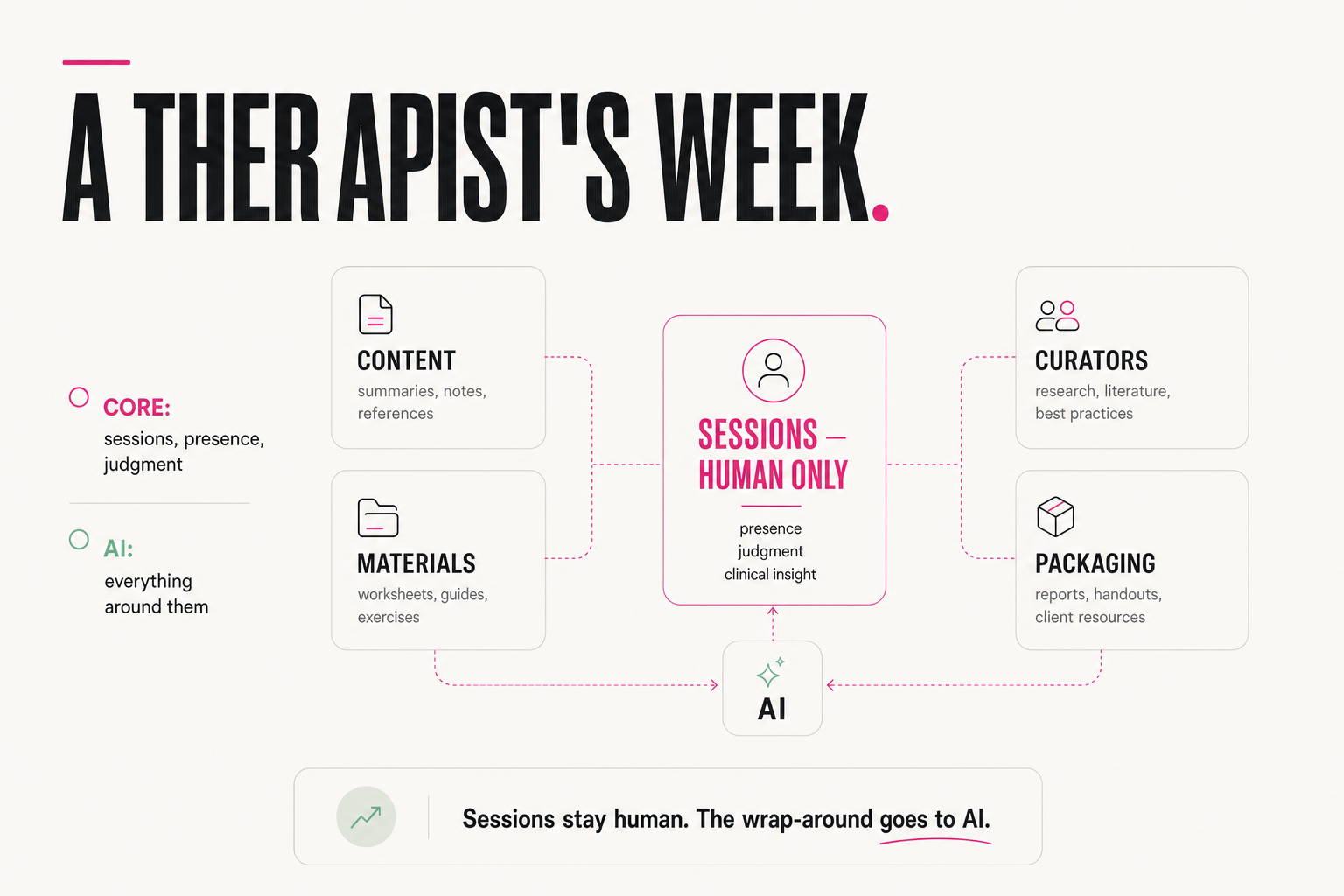
Per the focus-group cases — not therapy, but the wrapping around it:
- Content and marketing — the most common pain: "no time for content and marketing." Posts, warm-ups, product descriptions built from their own materials.
- Team work — one psychologist who trains specialists had "a giant headache with curators": assistants took over standard replies and materials, and the curators burned out less.
- Knowledge packaging — turning what they say out loud into structured products (the most elegant pattern — below).
- Communication analysis — mining past messages and consults to extract checklists and sales scripts.
"Here are 10 of my messages with clients at the first-consult
stage [paste, anonymized]. Find the recurring questions,
objections, and phrasings that resolved doubt. Assemble a
checklist of questions for a first meeting and 3 ready phrases
for common objections."
03 — The pattern
How does a voice note become a lead magnet in 20 minutes?
The most reproducible pattern in the cases: the psychologist records a thought by voice — the way she'd explain it to a client — and hands the transcript to AI with the instruction "assemble a lead magnet: structure, headline, examples from the text, takeaway." The output is a finished piece in 10–20 minutes instead of an evening at the laptop.
Why it works so well for psychologists: they explain better out loud than in writing — living phrasings, real examples, empathy. AI here doesn't "write for the expert" — it repackages what the expert already said. One participant named an unexpected side effect: "AI is a mirror of my discipline and communication" — output quality directly reflects the clarity of her own thinking.
"Here's the transcript of my voice note: [paste it].
Assemble a lead magnet from it: a hook headline, a structure
of 3–5 points, one concrete example from my text per point,
a closing takeaway. Use ONLY my phrasing — don't add anything
of your own."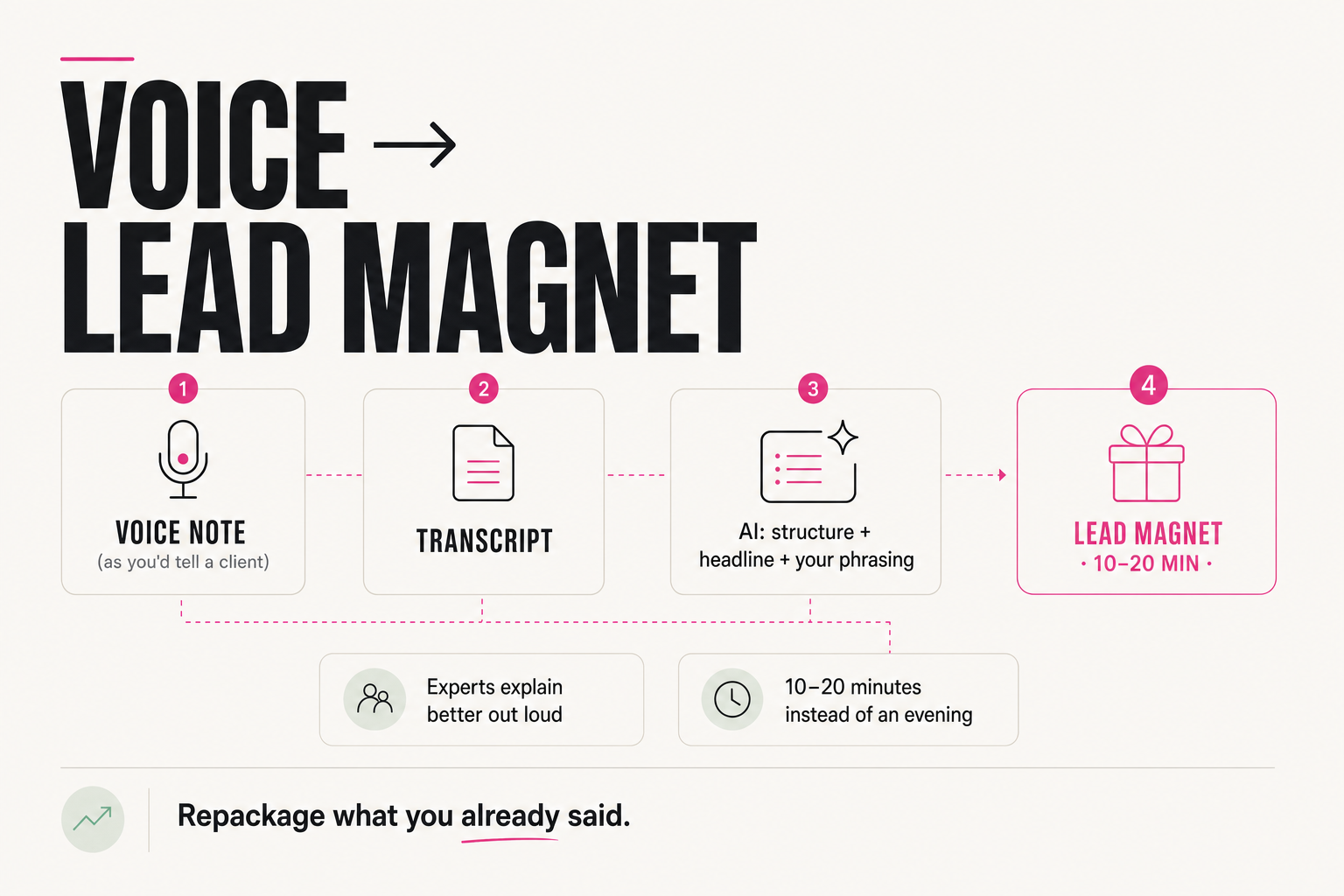
04 — Ethics
Where does the ethical line run?
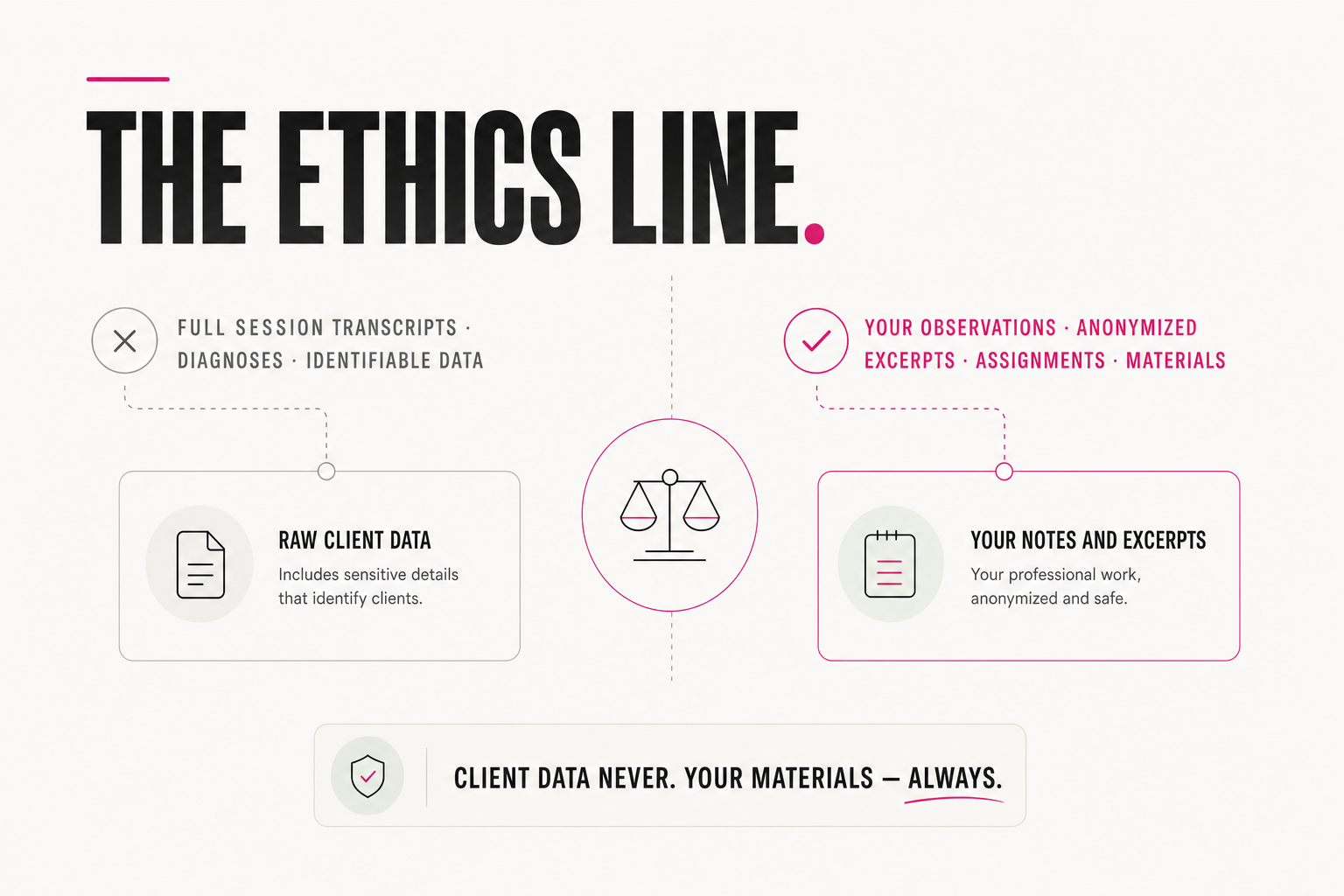
A hard rule, confirmed by corporate practice too: full transcripts of client conversations never go to AI. That's confidential data, and no convenience outweighs it.
But the boundary doesn't kill the value — it carves the channel. Allowed: drafting personal assignments from your own observations (no raw client data), analyzing anonymized excerpts, preparing session structure, assembling materials. Not allowed: uploading full sessions, diagnoses, identifiable details. The practical move: work from your notes about the session, not from the recording of it.
The full session recording/transcript, diagnoses, names and identifiable client details in a prompt.
"I had a session about [anonymized topic]. I noticed [your observation]. Help me turn this into an exercise for clients with a similar request."
05 — What stays
What remains only with the psychologist?
The session. Presence. Judgment in hard situations. Responsibility. AI doesn't replace the therapeutic contact — it removes what keeps you from focusing on it.
That's the answer to the "AI will replace psychologists" fear: what gets replaced isn't the psychologist but their routine. One finding across the base: specialists who digitized their method got more confident — "I'm not being replaced, I'm being amplified." And the first money comes fast: for one participant, a new product assembled with AI brought its first revenue while the cohort was still running.
Goes to AI:    formatting, structure, a draft, finding recurring
               patterns in YOUR OWN materials
Stays with you: the in-session call, empathy, responsibility for
               the diagnosis and treatment plan, live contact
Rule: if it's about WHAT to say to a client in the moment — yours.
      If it's about HOW to package what you already know — AI's.
06 — Where to start
Where should a psychologist start this week?
1. Voice-record the one topic you explain to clients most often
2. Transcript → AI: "assemble a lead magnet: structure, headline,
   examples from my text, takeaway; keep my phrasing"
3. Edit the meaning, don't rewrite — 10–20 minutes
4. Rule: raw client data never goes into AI
5. Worked? Save the prompt and repeat weeklyAI for a psychologist isn't a "robot therapist" — it's a way to reclaim time for therapy: content from voice notes, assistants for curators, knowledge packaging. The line is simple: your materials — yes, client data — never.
FAQ
Will AI replace psychologists?
Therapeutic contact, presence and responsibility can't be delegated. Per the focus-group cases, what gets replaced is the routine around sessions: content, materials, curator work, product packaging. Specialists who digitized their method feel more confident, not "replaced" — and explain their difference from free ChatGPT to clients better.
Can I upload session transcripts to AI?
Full transcripts — no; that's confidential client data. The working channel: draft assignments from your own observations, analyze anonymized excerpts, work from your notes about the session rather than its recording. The boundary doesn't kill the value — almost all the routine lies outside raw client data.
What should a psychologist delegate first?
Content from voice notes: record the topic you explain most often and ask AI to assemble a lead magnet from the transcript, keeping your phrasing. Per the cases this yields a finished piece in 10–20 minutes and pays back fastest. Next — assistants for curators' standard replies.
What does it mean in money?
Knowledge packaging monetizes fastest: for one focus-group participant, a product assembled with AI from her own materials brought its first revenue while the cohort was still running. Plus the reclaimed hours: the routine around sessions shrinks, and client capacity stops being capped by your evening energy.