AI against burnout: it's not about delegation, it's about energy
The brain gives energy when it sees a result. AI shortens the path to a result from a week to an hour — and work becomes a game again.

01 — The creep
How does routine turn into burnout?
Know the feeling? You make another post, package a funnel, or build a landing page — and it no longer inspires. It just has to be done. The task list grows, energy drops, and "when will this end" keeps spinning in your head.
When work stops feeling light and exciting and becomes routine, burnout is a matter of time. I knew that feeling for years. And it turned out to be not just about the volume of tasks, but about too long a gap between effort and result.
1. The task is done, but there's zero satisfaction — just a checkbox
2. The task list grows faster than you can feel the payoff
3. "When will this end" shows up before you start, not after
2+ signs? The issue isn't task volume — it's the length of the
"effort → result" loop. That's what to shorten first.
02 — Energy from results
Why does a slow result drain you?
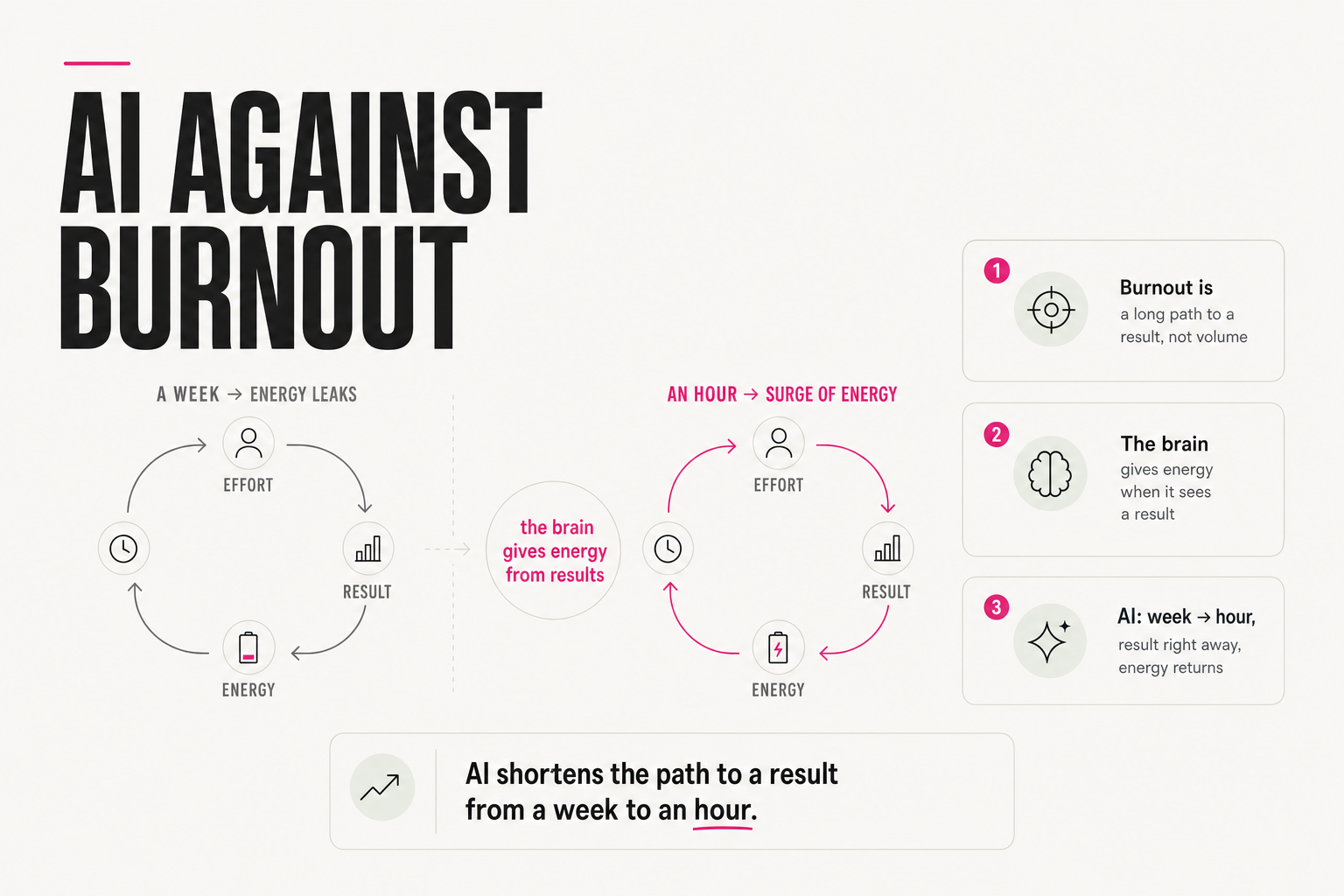
Our brain is wired to give energy when it sees a result. There's a result — there's energy for the next step. No result for weeks — the tank empties, even if you "worked a lot."
The brain gives energy when it sees a result. When there is one, there's more energy to keep building.— Anjela Petkova
That's the trap of routine: you put in effort, and a tangible result keeps getting postponed. The "effort → result → energy" loop stretches out — and instead of recharging you get a slow draining.
For each task this week, log:
Task: ____   Started at: ____   Saw a result at: ____
Loop length (hours): ____

A loop over a day long is a candidate for "do it with AI in an hour."
The goal isn't "work less" — it's shrinking the week's average loop.
03 — The short loop
How does AI bring energy back?
AI speeds up exactly this loop. Instead of fiddling with a task for a week, you do it in an hour. You see the result right away. You get energy. And that energy pushes you forward.
A week of fiddling → result far off → energy leaks → "when will this end."
An hour → result right away → a surge of energy → pulls you to the next.
So AI works against burnout not as "fewer tasks" but as "faster payoff." The same work, but the brain gets back the fuel it does anything for in the first place.
04 — More than delegation
Why isn't it only about saving time?
Working with AI isn't only optimization and delegating routine. There's an extra feeling that changes your whole relationship to the work: "I can take 10 different variants, test them all, and get a multiple of the result in the same time I used to spend."
Or: "I can stop postponing an idea for months and consult AI right here, break the process down, and start." That builds confidence that you can pull off any idea and launch any product — and it won't be a titanic effort. And it's exactly the sense of powerlessness in front of the volume that fuels burnout.
Here's my task: [describe]. Give me 10 different approaches to it —
different angles, tone, format. 2-3 lines each so I can compare
quickly. I'll pick 1-2 and ask you to expand them in full.
05 — A game again
How do you bring the excitement back?
When the result loop is short and you carry the sense of "I can try anything," work stops being a chore. You can again: test ten hypotheses, not be afraid to take on the new, get a multiple of the result you used to.
And when that feeling appears — work becomes a game again. The very one you started all this for. It's not about "optimizing tasks," it's about getting back the state where the work sparks excitement and interest, not fatigue.
Name an idea you've put off for months: ____
Why did you put it off? (too much work / scary / no time)
Ask AI: "break [idea] into 3 small steps I can start today."
Do the first step in an hour. That's the "game" part right there.
06 — Where to start
Where do you start if you're already on the edge?
Take one task that's hanging over you and do it with AI in an hour instead of a week — so you see a result today and feel the surge. Don't optimize everything at once; bring back one fast "effort → result → energy" loop, and it'll pull the next.
1. Name ONE task that's hanging over you right now
2. Open AI and describe it in 2 minutes — no perfect prompt needed
3. Ask for a first draft, not "the perfect solution"
4. Push it to a result in an hour — even an imperfect one
5. Notice the energy. That's your signal to start the next loopBurnout isn't about "too much work" — it's about too long a path to a result. AI shortens that path from a week to an hour: the brain sees payoff again and gives energy. Plus the confidence "I can test anything" — and work becomes a game again.
FAQ
How are AI and burnout connected?
Burnout creeps in when work becomes routine and the result keeps getting postponed — the brain stops getting fuel. AI shortens the path to a result from a week to an hour: you see the payoff right away and get energy. It's not about "fewer tasks" but faster payoff for the same effort.
Why isn't it only about delegating routine?
Delegation saves time, but something else works harder against burnout — the feeling "I can test 10 variants and get a multiple of the result in the same time." Confidence appears that any idea is doable and won't be a titanic effort. And powerlessness in front of the volume is exactly what fuels burnout.
Why does the brain give energy from a result?
That's how it's wired: it sees a result, it releases energy for the next step. When weeks pass between effort and result, the tank empties even if you worked a lot. A short "effort → result → energy" loop recharges; a long one drains. AI shortens exactly that loop.
Where do I start if I'm already burning out?
With one task that's hanging over you: do it with AI in an hour instead of a week, so you see a result today and feel the surge. Don't optimize everything at once — bring back one fast payoff loop and it'll pull the next. Energy comes back from a result, not from resting into a void.